
Hemipachnobia
McDunnough, 1929
Species Guides
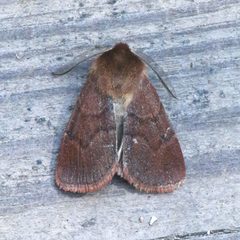
1- Hemipachnobia monochromatea(Sundew Cutworm Moth)
Hemipachnobia is a small of owlet moths in the Noctuidae, Noctuinae, established by James Halliday McDunnough in 1929. The genus contains two recognized : H. monochromatea (Morrison, 1874) and H. subporphyrea (Walker, 1858). It is native to North America with documented occurrences in the northeastern United States, particularly Vermont. As a noctuine noctuid, its members are presumed to be and possess the characteristic stout-bodied, cryptically colored typical of this diverse family.
Pronunciation
How to pronounce Hemipachnobia: //ˌhɛmɪˌpækˈnoʊbiə//
These audio files are automatically generated. While they are not always 100% accurate, they are a good starting point.
Identification
Hemipachnobia can be distinguished from related noctuine by subtle wing pattern characteristics, though specific diagnostic features require examination of genitalia . The genus name suggests a partial resemblance to the genus Pachnobia. Species-level identification relies on forewing coloration and pattern details: H. monochromatea exhibits relatively uniform grayish-brown forewings, while H. subporphyrea shows more pronounced purplish or rosy tints in the wing scaling.
Images
Distribution
Documented from the northeastern United States, with confirmed records from Vermont. The appears to have a restricted North American range, though precise boundaries remain poorly defined due to limited sampling and taxonomic study.
Similar Taxa
- PachnobiaThe name Hemipachnobia ('half-Pachnobia') indicates morphological similarity; both genera share Noctuinae placement and likely exhibit convergent wing patterns and body form.
- Other Noctuinae generaMany small noctuine share the stout body, dull coloration, and habits that characterize Hemipachnobia; precise separation requires genitalic examination.
More Details
Taxonomic history
The was erected by Canadian entomologist James Halliday McDunnough in 1929 to accommodate previously assigned to other genera. The type species is Hemipachnobia subporphyrea (originally described as Mamestra subporphyrea by Walker in 1858).
Research needs
Hemipachnobia remains poorly studied; basic including larval plants, stages, and precise geographic range are unknown. The would benefit from modern molecular phylogenetic analysis to clarify its position within Noctuinae.