
Choephora fungorum
Grote & Robinson, 1868
Bent-lined Dart, bent-line dart
Choephora fungorum, known as the bent-lined dart, is a noctuid native to eastern North America. are active in autumn and possess a wingspan of 33–47 mm. The is notable for its broad geographic range spanning from southern Canada to the Gulf Coast.

Pronunciation
How to pronounce Choephora fungorum: /kʰoʊˈɛfɔrə fʌŋˈɡoʊrəm/
These audio files are automatically generated. While they are not always 100% accurate, they are a good starting point.
Identification
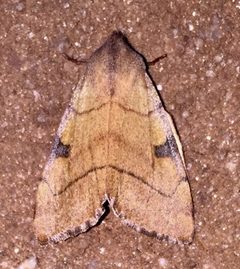
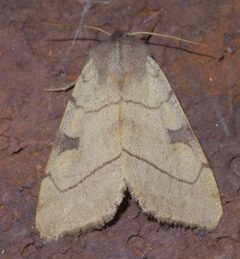
The bent-lined dart can be recognized by the characteristic bent or angled transverse line on the forewings. The is most reliably identified by this wing pattern in combination with its autumn period and eastern North American distribution.
Images
Appearance
have a wingspan of 33–47 mm. The refers to a diagnostic bent or angled line on the forewings.
Habitat
Occurs in a variety of open and semi-open across eastern North America, including fields, meadows, and disturbed areas where larval plants grow.
Distribution
Eastern North America from southern Ontario, Pennsylvania, and southern Michigan south to the northern Gulf Coast of Florida, and west to central Kansas and eastern Texas.
Seasonality
fly from September to November, with timing varying by latitude and local conditions.
Diet
Larvae feed on Trifolium (clover), Nicotiana (tobacco), and various herbaceous weeds. Larvae have been successfully reared on Taraxacum (dandelion) .
Host Associations
- Trifolium - larval food plant
- Nicotiana - larval food plant
- Taraxacum - larval food plantused in captive rearing
Life Cycle
Complete with , larval, pupal, and stages. Larvae are herbivorous and feed on low-growing herbaceous plants. Adults are and active in autumn.
Behavior
are and attracted to light. period is restricted to autumn months.
Ecological Role
Larvae function as herbivores in early successional and open . may serve as prey for including bats and birds.
Human Relevance
Larvae occasionally feed on cultivated tobacco (Nicotiana), potentially causing minor agricultural concern. Otherwise of limited economic significance.
Similar Taxa
- Other Choephora speciesCongeneric may share general Noctuinae ; reliable separation requires examination of genitalia or detailed wing pattern analysis
- Other autumn-flying NoctuinaeMultiple noctuid share similar size, coloration, and autumn ; the bent forewing line is diagnostic for C. fungorum
More Details
Taxonomic history
Described by Grote and Robinson in 1868. The epithet "fungorum" (of mushrooms) appears to be a misnomer, as larvae feed on herbaceous plants rather than fungi.
Sources and further reading
- BugGuide
- Wikipedia
- GBIF taxonomy match
- iNaturalist taxon
- NCBI Taxonomy
- Catalogue of Life
- How the names of organisms help to turn ‘small data’ into ‘Big Data’ | Blog
- Open minded and open access: NeoBiota, a new publishing platform for invasion biologists | Blog
- MycoKeys: A new peer-reviewed, open-access, high-technology journal in systematics and biology of fungi (including lichens) launched! | Blog
- Charles Sherborn | Blog