
Aplectoides condita
Guenée, 1852
Large-spotted Dart
Aplectoides condita is a noctuid native to North America, commonly known as the Large-spotted Dart. The has a transcontinental distribution across central and southern Canada, with southern extensions into the eastern United States and the Rocky Mountain region. are active from late spring through mid-summer. Larvae have been successfully reared on conifer , showing a documented preference for tamarack over balsam fir.
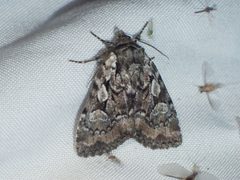
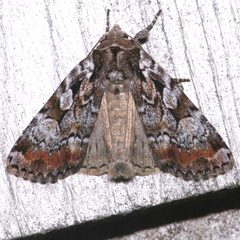
Pronunciation
How to pronounce Aplectoides condita: /æplɛkˈtɔɪdiːz kənˈdaɪtə/
These audio files are automatically generated. While they are not always 100% accurate, they are a good starting point.
Identification
The combination of geographic range (northeastern and north-central North America), period (May–July), and association with coniferous forests may aid in identification. The "Large-spotted Dart" suggests distinctive spotting on the forewings, though specific pattern elements are not described in available sources.
Images
Appearance
have a wingspan of approximately 33 mm. The exhibits the typical noctuid body plan with scaled wings and a robust . Specific wing pattern details are not documented in available sources.
Habitat
Associated with coniferous forests, as evidenced by larval plant records. The distribution pattern suggests occupancy of and northern temperate forest zones, including Appalachian montane forests at southern range limits.
Distribution
Native to North America. Found across central and southern Canada from Newfoundland to British Columbia. In the eastern United States, occurs south to northern New Jersey, northern Pennsylvania, Michigan, and Wisconsin, with disjunct along the Appalachians in Virginia, North Carolina, and recently recorded Tennessee. Western U.S. records include Idaho and Oregon.
Seasonality
are active from May to July. Larval development presumably occurs prior to adult , though specific timing is not documented.
Diet
Larvae feed on conifers. Documented include Abies balsamea (balsam fir) and Larix laricina (tamarack), with observed preference for the latter.
Host Associations
- Abies balsamea - larval reared in captivity; accepted but not preferred
- Larix laricina - larval reared in captivity; preferred over Abies balsamea
Life Cycle
Complete with , larva, pupa, and stages. Larvae have been reared in captivity, confirming feeding on conifer foliage. Specific details on stage, number of , or site are not documented.
Behavior
activity is inferred from -level traits, though not explicitly documented for this . Larvae are folivorous on conifer needles.
Ecological Role
Larval herbivore in coniferous forest . Specific ecological impacts or are not documented.
Human Relevance
No documented economic importance. Occasionally encountered by naturalists and enthusiasts. Recorded in biodiversity surveys including Great Smoky Mountains National Park.
Similar Taxa
- Other Aplectoides species-level similarity in and ; precise differentiation requires examination of genitalia or other subtle characters not described in general sources
- Other Noctuinae in coniferous habitatsShared and general noctuid appearance; A. condita may be distinguished by geographic range, period, and associations where known
More Details
Taxonomic history
Originally described as Aplecta condita by Guenée in 1852, later transferred to Aplectoides.
Recent range extension
Tennessee represents a recent southern range record, suggesting either historical under-sampling or range expansion.