
Abagrotis vittifrons
Grote, 1864
Pale-edged Dart
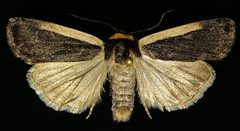
Abagrotis vittifrons, commonly known as the Pale-edged Dart, is a noctuid first described by Augustus Radcliffe Grote in 1864. It is found in western North America, ranging from the northern Great Plains to the Pacific coast and southward to the southwestern United States. The has a single with active in late summer.
Pronunciation
How to pronounce Abagrotis vittifrons: /ˌæbəˈɡroʊtɪs ˌvɪtɪˈfrɒnz/
These audio files are automatically generated. While they are not always 100% accurate, they are a good starting point.
Identification
Available sources do not provide specific diagnostic features to distinguish this from other Abagrotis species.
Images
Appearance
Wingspan approximately 34–35 mm. Specific coloration and pattern details are not documented in available sources.
Habitat
Inhabits regions from the northern Great Plains through western mountain and coastal areas to the southwestern United States. Specific microhabitat preferences are not documented.
Distribution
North America: eastern North Dakota and southwestern Saskatchewan west to the southern interior of British Columbia, south to southern California, Arizona, and New Mexico. Distribution records confirm presence in Alberta, Manitoba, and Saskatchewan, Canada.
Seasonality
are on wing from August to September in one per year, with timing varying by location.
Life Cycle
Single per year (). Detailed stages are not documented in available sources.
Behavior
activity in late summer. Other are not documented.