
Euxoa tristicula
Morrison, 1876
early cutworm
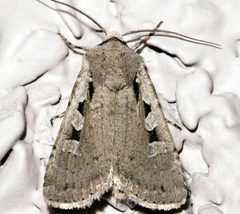
Euxoa tristicula, the early , is a noctuid found along the Pacific coast of North America from British Columbia to central California. have a wingspan of 38–42 mm and are active from late spring through early September. The inhabits coastal rainforests and mixed forest west of the Cascade Mountains.
Pronunciation
How to pronounce Euxoa tristicula: /juːkˈsoʊ.ə trɪsˈtɪk.jʊ.lə/
These audio files are automatically generated. While they are not always 100% accurate, they are a good starting point.
Identification
Distinguished from similar Euxoa by its coastal distribution west of the Cascade Mountains and period from late spring to early September. The specific epithet 'tristicula' and association with early-season activity ('early ') may aid separation from related cutworms with different or geographic range. Accurate identification typically requires examination of genitalic structures.
Images
Habitat
Coastal rainforests, mixed hardwood forests, and mixed hardwood-conifer forests at low to middle elevations west of the Cascade Mountains.
Distribution
Pacific coastal region of western North America: southern British Columbia, Canada; south through Oregon to central California, USA. Records also include interior provinces of Alberta, Manitoba, and Saskatchewan in Canada.
Seasonality
on wing from late spring to early September. Larval stage active during cooler months, with cutworms typically as larvae and resuming feeding in spring.
Life Cycle
Complete with , larva, pupa, and stages. As a typical , larvae likely overwinter in soil or under debris, with occurring in soil. Eggs probably laid on soil or vegetation in late summer or fall, hatching in 2–14 days based on related Euxoa .
Behavior
are . Larvae exhibit typical : nocturnal feeding, hiding in soil or under debris during daylight hours, and curling into a defensive C-shape when disturbed.
Ecological Role
Larvae function as herbivores and agricultural pests, feeding on plant stems and cutting seedlings at or below soil surface. likely serve as prey for including bats and birds.
Human Relevance
Agricultural pest as larval cutworms damage field crops including sorghum, small grains, and other seedlings by cutting stems at soil level. Management includes cultural controls (weed destruction, clean ) and targeted applications.
Similar Taxa
- Euxoa auxiliaris (army cutworm)Overlaps in western North American range and shares larval habits; differs in being a more widespread interior plains with distinctive migratory and different .
- Other Euxoa speciesNumerous congeneric in western North America require genitalic dissection for definitive separation; E. tristicula distinguished by coastal distribution and early-season activity.
- Agrotis speciesRelated noctuid cutworms with similar larval damage ; separated by subtle morphological differences in and often require expert identification.
More Details
Taxonomic history
First described by Herbert Knowles Morrison in 1876. The specific epithet and 'early ' suggest this may have earlier seasonal activity than related cutworms, though detailed comparative phenological studies are lacking.
Conservation status
Not evaluated; appears to be relatively common within its restricted coastal range based on 79 iNaturalist observations, though specificity to coastal forests west of the Cascades may limit overall abundance.
Sources and further reading
- BugGuide
- Wikipedia
- GBIF taxonomy match
- iNaturalist taxon
- NCBI Taxonomy
- Aboveground Pests - AgriLife Extension Entomology
- Stem- and Leaf- Feeding Insects - AgriLife Extension Entomology
- Bug Eric: Winter 'pillars
- How Army Cutworm Moths Bounce Between Midwest Heat and Alpine Cool
- Bug Eric: My Kind of Fourth of July
- Bug Eric: July 2019