
Agrotis apicalis
Herrich-Schäffer, 1868
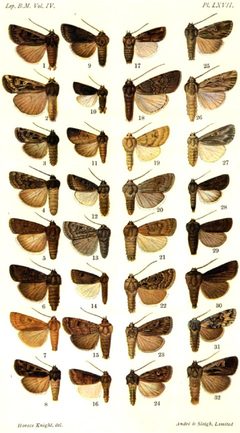
Agrotis apicalis is a noctuid described by Herrich-Schäffer in 1868. It has a wingspan of approximately 38 mm. The is restricted to the Caribbean region and Florida, with records from the Dominican Republic, Jamaica, Puerto Rico, Cuba, and Florida. Like other members of the Agrotis, it is likely and attracted to light sources.
Pronunciation
How to pronounce Agrotis apicalis: /əˈɡroʊtɪs ˌæpɪˈkeɪlɪs/
These audio files are automatically generated. While they are not always 100% accurate, they are a good starting point.
Identification
The specific identification features distinguishing Agrotis apicalis from other Agrotis are not documented in available sources. Identification likely requires examination of genitalia or other subtle morphological characters typical of noctuid .
Images
Distribution
Florida, United States; Dominican Republic; Jamaica; Puerto Rico; Cuba. The has a Caribbean distribution with a northern extension into Florida.
Behavior
; likely attracted to light sources based on typical noctuid and the observation context of related .
More Details
Taxonomic history
First described by German entomologist Gottlieb August Wilhelm Herrich-Schäffer in 1868, a prominent 19th-century lepidopterist who described numerous Neotropical .
Collection records
The is represented by only 14 observations in iNaturalist as of the source date, suggesting it may be genuinely uncommon, under-collected, or restricted to specific within its range.
Sources and further reading
- BugGuide
- Wikipedia
- GBIF taxonomy match
- iNaturalist taxon
- NCBI Taxonomy
- Catalogue of Life
- Encyrtid Holdings | Entomology Research Museum
- Congrats to Antoine Abrieux, Innovator Fellow Award | Bug Squad
- Occasional Pests - AgriLife Extension Entomology
- Meloidae Holdings | Entomology Research Museum
- Insect-resistant Maize Could Increase Yields and Decrease Pesticide Use in Mexico
- Bug Eric: Last Night to Blacklight?