
Actebia fennica
(Tauscher, 1806)
Finnish Dart, black army cutworm, Eversmann's rustic
Actebia fennica is a noctuid with a Holarctic distribution spanning regions of North America and Eurasia. are active from July to September with a single per year. The exhibits a documented behavioral response to landscape fire smoke, with females doubling production when exposed to volatiles from burning vegetation. Larvae feed on a diverse range of plants including grasses, forbs, and woody species in coastal and disturbed .
Pronunciation
How to pronounce Actebia fennica: /ækˈtiːbiə ˈfɛnɪkə/
These audio files are automatically generated. While they are not always 100% accurate, they are a good starting point.
Identification
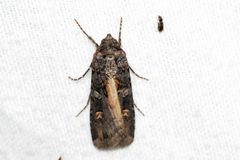
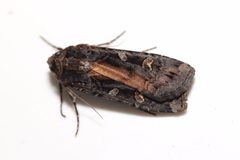
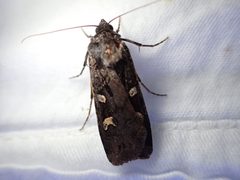
Distinguished from similar noctuids by the combination of moderate size (wingspan 39–42 mm), dull brownish-gray forewing coloration with variable dark patterning, and pale hindwings with dark margins. The Holarctic distribution and late-summer period help separate it from related Actebia with more restricted ranges. Genitalia examination may be required for definitive identification from closely similar .
Images
Appearance
have a wingspan of 39–42 mm and body length of approximately 23 mm. Forewings are typically dull brownish-gray with variable darker markings. Hindwings are pale with darker margins. The overall coloration provides cryptic camouflage against soil and vegetation substrates.
Habitat
Occupies and subarctic environments including coastal dunes, sandy grasslands, disturbed open areas, and tundra-edge . Associated with early successional vegetation and areas with sparse, low-growing plants. In North America, primarily found in the boreal zone with scattered southward in suitable open habitats.
Distribution
Holarctic distribution: Newfoundland across northern and western Europe through Siberia, Russian Far East, Mongolia, northern China, Korea, and Japan. In North America, widespread in the region from Alaska and Canada south to New England, southern Montana, and northern Oregon. Documented Canadian provincial records include Alberta, Manitoba, and Saskatchewan.
Seasonality
are on wing from July to September, with exact timing varying by latitude and local climate. Single per year ().
Diet
Larvae feed on Elymus arenarius (lyme grass), Rumex (including Rumex acetosella, sheep sorrel), Atriplex species (saltbushes), Minuartia pebloides, Lathyrus maritimus (beach pea), Salix species (willows), and Vaccinium uliginosum (bog bilberry). feeding habits are not documented.
Host Associations
- Elymus arenarius - larval food plantLyme grass
- Rumex acetosella - larval food plantSheep sorrel
- Atriplex - larval food plantSaltbushes; -level association
- Minuartia pebloides - larval food plant
- Lathyrus maritimus - larval food plantBeach pea
- Salix - larval food plantWillows; -level association
- Vaccinium uliginosum - larval food plantBog bilberry
Life Cycle
One per year (). Larval development occurs through spring and early summer, with in soil or concealed locations. emerge in mid to late summer. stage is not explicitly documented in available sources but is likely as or larva given typical noctuid patterns in regions.
Behavior
Females have been documented to double oviposition rates when exposed to volatiles from burning vegetation, a behavioral response linked to increased reproductive . This smoke-associated suggests to post-fire environments where larval plants may flourish. are and attracted to light.
Ecological Role
Herbivorous larvae contribute to nutrient cycling in early successional and coastal dune . The documented positive response to fire smoke suggests a role in post-fire assembly, potentially facilitating rapid of burned . Serves as prey for insectivorous birds, bats, and other in .
Human Relevance
The "black " suggests historical agricultural association, though specific crop damage records are not documented in provided sources. The serves as a research subject for understanding insect responses to landscape fire and climate-related disturbance regimes. Not known to be of significant economic importance.
Similar Taxa
- Actebia praecoxSimilar size and coloration in Palearctic region; distinguished by earlier period and more southern distribution
- Actebia squalidaOverlapping Holarctic range; requires genitalia examination for definitive separation
- Other Noctua/Noctuini speciesSimilar dull brownish-gray forewing pattern; distinguished by combination of size, hindwing coloration, and distribution
More Details
Response to Fire Smoke
Research published in Environmental Entomology (Liu et al. 2022) documented that A. fennica females doubled production when exposed to smoke volatiles from burning vegetation, mediated by increased reproductive . This represents one of the few documented cases of positive effects from landscape fire smoke in Lepidoptera.