
Protorthodes mulina
(Schaus, 1894)
Protorthodes mulina is a small noctuid first described by William Schaus in 1894. The occurs in the southwestern United States and Mexico, with a probable wide distribution in Mexico extending south to Chiapas. are active during two periods: May–June and mid-August to early November, suggesting . The species is known from relatively few localities despite its likely broad range.
Pronunciation
How to pronounce Protorthodes mulina: /proʊˈtɔr.θə.deɪz ˈmjuː.lɪ.nə/
These audio files are automatically generated. While they are not always 100% accurate, they are a good starting point.
Identification
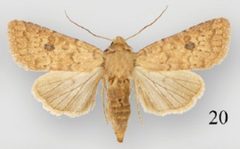
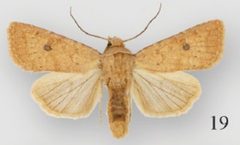
Distinguished from similar Protorthodes by the combination of small size (forewing 13–17 mm), bright orange to yellow-orange ground color, and the specific pattern of darker orange-brown lines on the forewings. The bimodal period (spring and late summer–fall) may aid in field identification timing.
Images
Appearance
Small with forewing length of 13–17 mm. Forewing ground color is orange or yellow-orange, overlaid with darker orange-brown lines. Wing pattern consists of contrasting dark linear markings on a bright orange background.
Distribution
United States: western Texas to southeastern Arizona. Mexico: probably widespread, recorded south to Chiapas, but known from very few localities.
Seasonality
on wing in May and June, and again from mid-August to early November. Two per year inferred from bimodal pattern.
Life Cycle
; two periods per year.
Similar Taxa
- Other Protorthodes speciesSimilar size and general ; distinguished by specific forewing coloration and pattern of P. mulina
More Details
Taxonomic history
Originally described as Taeniocampa mulina by Schaus in 1894; later transferred to Trichopolia and subsequently to Protorthodes. Listed as a synonym in some sources (Catalogue of Life) but accepted in others (GBIF, NCBI).
Collection rarity
Despite probable wide distribution in Mexico, the is known from very few documented localities, suggesting it may be undercollected or genuinely rare in occurrence.