
Homorthodes lindseyi
(Benjamin, 1922)
Southern Scurfy Quaker
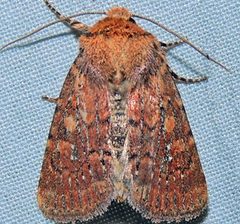
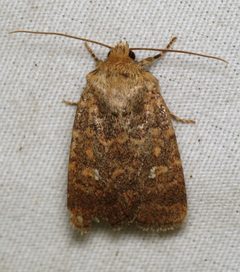
Homorthodes lindseyi, the Southern Scurfy Quaker, is a noctuid native to eastern and central North America. Formerly treated as a of Homorthodes furfurata, it was elevated to full status based on morphological and geographic distinctions. It belongs to the tribe Eriopygini within the Noctuinae. The species is moderately well-documented with over 1,000 observations, primarily from the United States.
Pronunciation
How to pronounce Homorthodes lindseyi: /hoʊˈmɔrθoʊˌdiːz ˈlɪndsi.aɪ/
These audio files are automatically generated. While they are not always 100% accurate, they are a good starting point.
Identification
Distinguished from Homorthodes furfurata by geographic range and subtle genitalic differences; H. lindseyi occurs in the southern and eastern United States while H. furfurata is more northern. Forewing ground color is dull brownish-gray with a slightly scurfy or powdery appearance. The and spots are usually present but indistinct. Hindwings are pale grayish-brown with darker discal spot and terminal line. Specimens require dissection or molecular analysis for definitive separation from closely related Homorthodes .
Images
Distribution
Eastern and central North America, from New Jersey west to Oklahoma and southward. Records indicate presence throughout the southeastern United States and into the southern Great Plains.
Similar Taxa
- Homorthodes furfurataFormerly considered ; northern distribution, subtle wing pattern and genitalic differences separate the two
- Homorthodes rectaOverlapping range; requires examination of male genitalia for reliable separation
More Details
Taxonomic History
Originally described as Eriopyga lindseyi by Benjamin in 1922, later transferred to Homorthodes as a of H. furfurata, and finally elevated to full status based on morphological and distributional evidence.
Nomenclatural Note
The basionym Eriopyga lindseyi reflects the original placement in the Eriopyga before transfer to Homorthodes.