
Bryolymnia semifascia
Smith, 1900
half-banded bryolymnia, half-banded bryolymnia moth
Bryolymnia semifascia, known as the half-banded bryolymnia, is a small noctuid native to the southwestern United States. First described by John Bernhardt Smith in 1900, this inhabits conifer forests at moderate elevations. are active during summer months and are characterized by a distinctive wing pattern featuring a partial band.
Pronunciation
How to pronounce Bryolymnia semifascia: /braɪoʊˈlɪmnɪə sɛmɪˈfæʃə/
These audio files are automatically generated. While they are not always 100% accurate, they are a good starting point.
Identification
Distinguished from by the partial (half) transverse band on the forewing, rather than a complete band. The combination of small size (26–29 mm wingspan), southwestern U.S. distribution, and conifer forest helps separate it from similar Bryolymnia . Examination of genitalia may be required for definitive identification; see Lafontaine et al. (2010) for technical .
Images
Appearance
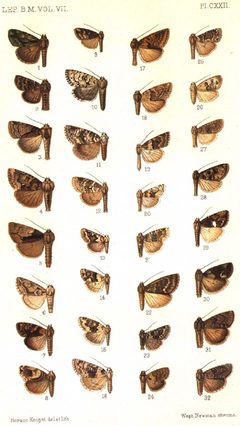
Small with wingspan of 26–29 mm. Forewings display a characteristic half-band pattern, with the basal portion darker and a lighter area distally. Overall coloration is muted, blending with bark and lichen substrates typical of conifer forest .
Habitat
Conifer forests, particularly in montane and submontane zones. Associated with pine, spruce, and fir dominated .
Distribution
to southwestern United States. Range extends from northern Colorado and southern Utah southward through south-central New Mexico to south-eastern Arizona.
Seasonality
active from mid-June to mid-September. Single per year () inferred from collection records.
Behavior
. attracted to light. Specific mating or oviposition unrecorded.
Ecological Role
Larval stage likely functions as a folivore in conifer forest , though specific plants unconfirmed. may serve as prey for including bats and night-foraging birds.
Human Relevance
Subject of taxonomic research; included in modern revision of North American Bryolymnia (Lafontaine et al., 2010). No economic or agricultural significance documented.
Similar Taxa
- Bryolymnia virgataOverlaps in distribution and ; distinguished by complete rather than partial forewing banding pattern and generally larger size.
- Bryolymnia martiSympatric in parts of range; separated by wing pattern details and male genitalia structure (see Lafontaine et al., 2010).
More Details
Taxonomic history
Originally described as Chytonix semifascia by Smith in 1900, transferred to Bryolymnia following generic revision. Basionym Chytonix semifascia retained as synonym.
Research importance
One of seven North American Bryolymnia treated in comprehensive taxonomic revision (Lafontaine, Walsh & Holland 2010), which clarified species boundaries and described three new .