
Papaipema circumlucens
Smith, 1899
hops-stalk borer moth, hop-gall borer moth
Papaipema circumlucens is a North American in the Noctuidae, described by Smith in 1899. The is known by two : hops-stalk borer moth and hop-gall borer moth. It is listed as a species of special concern and has been documented from Illinois, Indiana, Michigan, Missouri, New Hampshire, Ohio, Saskatchewan, and Wisconsin. It is believed to be extirpated from Connecticut.
Pronunciation
How to pronounce Papaipema circumlucens: //pəˌpaɪˈpiːmə sɚˌkʌmˈluːsɛnz//
These audio files are automatically generated. While they are not always 100% accurate, they are a good starting point.
Identification
The combination of small size (38 mm wingspan), pale stramineous forewings with faint markings, the distinctive oblique row of three white spots (claviform and ), and the purplish subterminal shade defining a yellow patch distinguishes this . The whitish hindwings contrast with the more patterned forewings. The faint, obscure wing lines separate it from more boldly marked Papaipema species.
Images
Appearance
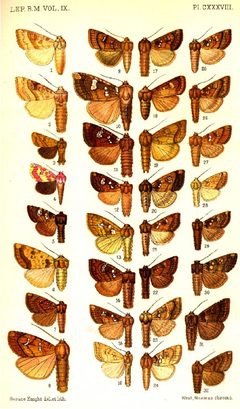
have a wingspan of approximately 38 mm. The forewings are pale stramineous (straw-colored) with only slight brown tinting. Wing markings are faint and obscure. The ordinary spots are white, with the claviform and spots forming an oblique row of three spots, the middle spot being smallest. The spot contains a white central line, and all surrounding spots are white. The subterminal shade is purplish, defining a yellow patch. The hindwings are whitish.
Distribution
Recorded from Illinois, Indiana, Michigan, Missouri, New Hampshire, Ohio, Wisconsin in the United States, and Saskatchewan (and potentially Manitoba) in Canada. Believed to be extirpated from Connecticut.
Host Associations
- Humulus lupulus - common hop, inferred from 'hops-stalk borer '
Human Relevance
Listed as a of special concern. The suggests potential association with hop , though specific economic impact is not documented. The species is considered extirpated from Connecticut, indicating conservation concern.
Similar Taxa
- Other Papaipema speciesPapaipema circumlucens is distinguished by its pale stramineous coloration with faint markings, smaller size, and distinctive spot pattern (oblique row of three white spots), whereas typically have darker or more boldly patterned forewings with more prominent lines.
More Details
Conservation Status
Listed as a of special concern. Believed extirpated from Connecticut.
Taxonomic History
Originally described as Hydroecia circumlucens Smith, 1899, later transferred to Papaipema.