
Melanapamea mixta
Grote, 1881
Charred Brocade, Coastal Plain Apamea
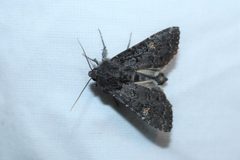
Melanapamea mixta, commonly known as the Charred Brocade or Coastal Plain Apamea, is a noctuid found in scattered across eastern North America. The species was originally described by Grote in 1881 under the Apamea and later transferred to Melanapamea. It exhibits a disjunct distribution pattern, occurring along the Atlantic coastal plain from Canada to the southeastern United States, with additional inland populations in the Great Lakes region and western Maryland. The species appears to be associated with coastal plain and sand dune , though specific ecological details remain limited.
Pronunciation
How to pronounce Melanapamea mixta: //ˌmɛl.ə.nəˈpiː.miː ˈmɪks.tə//
These audio files are automatically generated. While they are not always 100% accurate, they are a good starting point.
Images
Habitat
Associated with coastal plain and inland sand dune systems. Records indicate occurrence in vegetated sand dune habitats and mesquite/saltbush chaparral in the southwestern portion of its range. The has been documented in pinyon/oak/juniper woodland in Oklahoma and sand prairie habitats in New Mexico.
Distribution
Scattered from Ontario, Quebec, New Brunswick, Nova Scotia and Manitoba in Canada south along the Atlantic coast to New Jersey and North Carolina. Inland records from New York, western Maryland, Massachusetts, Maine, Michigan and Ohio. Western records from Oklahoma, New Mexico and Kansas.
Seasonality
have been observed from late May through June. Records indicate activity during late spring and early summer, with peak likely triggered by rainfall and warming temperatures in arid western portions of the range.
Behavior
are and attracted to light sources. In western portions of the range, adults have been observed resting on vegetation during daylight hours in cool conditions.