
Euros proprius
H. Edwards, 1881
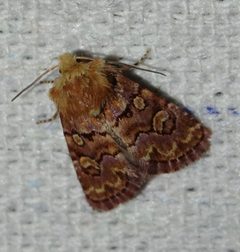
Euros proprius is a small noctuid described by Henry Edwards in 1881. It is the most distinctive within the Euros , characterized by its restricted range in the northern Sierra Nevada of California and specific association with riparian in dry forest . The species has a documented larval relationship with Paeonia brownii.
Pronunciation
How to pronounce Euros proprius: //ˈjʊəɹ.ɒs ˈprɒ.pri.əs//
These audio files are automatically generated. While they are not always 100% accurate, they are a good starting point.
Identification
Distinguished from other Euros by being the most morphologically distinctive member of the ; specific diagnostic characters not detailed in available literature. The combination of small size (forewings 9–10 mm), geographic restriction to northern Sierra Nevada, and association with streamside in dry forests may aid in field identification.
Images
Appearance
have forewings measuring 9–10 mm in length. As the most distinctive in the Euros , it exhibits morphological features that readily separate it from , though specific coloration and pattern details are not documented in available sources.
Habitat
Found near streams in dry forest environments. Occupies riparian corridors within otherwise xeric forested landscapes.
Distribution
to the northern Sierra Nevada in California, United States. Restricted to a specific geographic region with documented presence near streams in this mountain range.
Diet
Larvae feed on Paeonia brownii (Brown's peony). feeding habits are not documented.
Host Associations
- Paeonia brownii - larval plantconfirmed food source for larvae
Similar Taxa
- Other Euros speciesE. proprius is explicitly described as the most distinctive in the , implying are less readily distinguishable; however, specific differentiating characters for other species are not provided in available sources.
More Details
Taxonomic history
Described by Henry Edwards in 1881. The has been subject to modern taxonomic review, as referenced in a 2010 review of the Euros.
Conservation implications
The restricted geographic range and specific requirements (riparian zones in dry forests) suggest potential vulnerability to habitat alteration, though formal conservation status has not been assessed in available sources.
Sources and further reading
- BugGuide
- Wikipedia
- GBIF taxonomy match
- iNaturalist taxon
- NCBI Taxonomy
- Catalogue of Life
- Bug Eric: Spider Sunday: Marbled Cellar Spider
- Pensoft joins EU-funded project SOLO, supporting the EU Mission “A Soil Deal for Europe” | Blog
- Bug Eric: Missing Sector Orbweaver, Zygiella x-notata
- VIBRANT: New virtual research communities to create and share data on biodiversity | Blog
- Listen to the trees: a detective work on the origin of invasive species