
Apamea unanimis
(Hübner, 1813)
Small Clouded Brindle
Apamea unanimis, commonly known as the small clouded brindle, is a noctuid first described by Jacob Hübner in 1813. Native to Europe, Turkey, Azerbaijan, and western Siberia, it has been introduced to North America and is established in parts of Canada and the northern United States. The is associated with wetland where its larval plants grow.
Pronunciation
How to pronounce Apamea unanimis: /əˈpeɪ.mi.ə juːˈnæn.ɪ.mɪs/
These audio files are automatically generated. While they are not always 100% accurate, they are a good starting point.
Identification
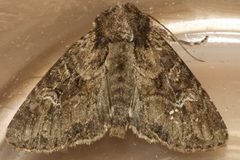
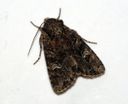
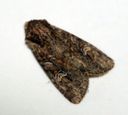
Distinguished from Apamea obscura by lacking the grey tinge and by the submarginal line not being acutely angled below the middle. The black streaks at the wing base, when present, are more pronounced than in typical A. obscura. The stigma with its white external edging is a useful character. Several aberrant forms exist, including ab. secalina with black submedian streak and paler basal and submarginal areas, and ab. rufithorax with bright and . Larvae may be confused with other Apamea but the combination of reddish clay-yellow ground color with yellow-white lines and black is characteristic.
Images
Appearance
have a wingspan of 30–38 mm. Forewings are brownish fuscous to red-brown, often with black streaks from the base below the and above the inner margin near the base. A blackish streak may occur on the submedian fold between the two lines. The stigma is externally edged with white. The terminal area is dusted with grey and less dark than related forms. Hindwings are pale. Larvae are reddish clay-yellow to yellow-brown with yellow-white and dorsolateral lines, a bright lateral stripe, and black . capsule, neck shield, and anal shield are brownish.
Habitat
Wetland including marshes, reedbeds, and edges of water bodies where larval plants occur. In North America, it has been recorded at light stations near wetlands and in prairie-oasis habitats with nearby water sources.
Distribution
Native to Europe, Turkey, Azerbaijan, and western Siberia. Introduced to North America with established in Ontario, Quebec, New Brunswick (Canada), and New York, Michigan, and Wisconsin (USA). GBIF records confirm presence in Belgium.
Seasonality
are on wing from June to July, with exact timing varying by location.
Diet
Larvae feed on common reed (Phragmites australis), canarygrasses (Phalaris spp.), and mannagrasses (Glyceria spp.). feeding habits are not documented.
Host Associations
- Phragmites australis - larval foodplantcommon reed
- Phalaris - larval foodplantcanarygrasses
- Glyceria - larval foodplantmannagrasses
Life Cycle
Complete with , larval, pupal, and stages. Larvae are described from collected specimens; specific details of site and stage are not documented in available sources.
Behavior
are and attracted to light. Larvae are concealed feeders within or on their grass .
Ecological Role
Larval herbivore in wetland , consuming emergent grasses and reeds. Specific role in is not documented.
Human Relevance
No significant economic or ecological impact documented. Occasionally encountered by enthusiasts at light traps. Introduced status in North America suggests human-mediated , but impacts on native are not recorded.
Similar Taxa
- Apamea obscuraSimilar forewing pattern but A. obscura has more grey tinge, less pronounced black basal streaks, and acutely angled submarginal line below middle
- Apamea secalisAberrant form ab. semiochrea of A. unanimis has been mistaken for A. secalis due to pale ochreous postmedian area
More Details
Aberrant forms
Multiple named aberrations exist: ab. submissa and ab. remissa with reduced or absent black basal streaks; ab. secalina with black submedian streak and paler areas; ab. rufithorax with and (known from single male specimen from Wiesbaden); ab. fasciata with dark fuscous area and conspicuous lines; ab. semiochrea with pale ochreous postmedian area.
North American introduction
Established in northeastern North America suggest successful following introduction, though the mechanism and date of introduction are not documented.