
Schinia nubila
Strecker, 1876
Camphorweed Flower Moth, Brown Flower Moth
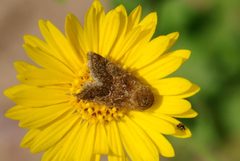
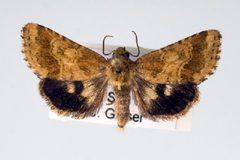
Schinia nubila, known as the camphorweed flower moth or brown flower moth, is a small noctuid described by Herman Strecker in 1876. The has a wingspan of 22–24 mm and completes one annually. Larvae have been documented feeding on Heterotheca subaxillaris and Solidago species. Its geographic range spans from Oklahoma to New Jersey, south to Florida and Texas, with documented expansion northeastward.
Pronunciation
How to pronounce Schinia nubila: /ˈskiː.ni.ə ˈnuː.bɪ.lə/
These audio files are automatically generated. While they are not always 100% accurate, they are a good starting point.
Identification
The can be distinguished from similar Schinia flower moths by its association with camphorweed (Heterotheca subaxillaris) and goldenrod (Solidago) , combined with its specific geographic distribution. Accurate identification may require examination of genitalia or reference to specialized noctuid identification keys.
Images
Appearance
Small with wingspan of 22–24 mm. are brown in coloration, consistent with the 'brown flower moth'. Detailed wing pattern descriptions are not available in the provided sources.
Habitat
Associated with open supporting plants Heterotheca subaxillaris (camphorweed) and Solidago (goldenrods). These are typically found in disturbed open areas, fields, and roadsides.
Distribution
Native to eastern and central North America. Documented from Oklahoma to New Jersey, south to Florida and Texas. Additional records from Colorado, Kansas, Arkansas, North Carolina, South Carolina, and Maryland. The ' range is actively expanding in the northeastern United States.
Seasonality
One per year. period not explicitly documented in sources, but likely corresponds with flowering of plants in late summer and fall.
Diet
Larvae feed on Heterotheca subaxillaris (camphorweed) and Solidago (goldenrods). feeding habits are not documented.
Host Associations
- Heterotheca subaxillaris - larval camphorweed
- Solidago - larval goldenrod
Life Cycle
(one per year). Larval stage feeds on plants. and details are not documented in available sources.
Behavior
No specific documented beyond larval feeding on plants.
Ecological Role
As a flower moth, larvae are herbivores on Asteraceae plants. Their role in pollination or as prey for other organisms is not documented.
Human Relevance
No documented economic or agricultural significance. Not known to be a pest .
Similar Taxa
- Other Schinia speciesThe Schinia contains numerous flower moths with similar and ; many require association and genitalia examination for reliable identification.
More Details
Taxonomic History
First described by Herman Strecker in 1876. The has been recorded under multiple reflecting its plant association (camphorweed) and coloration (brown).
Range Expansion
The is documented as expanding its range in the northeastern United States, though specific mechanisms or timing of this expansion are not detailed in available sources.
Sources and further reading
- BugGuide
- Wikipedia
- GBIF taxonomy match
- iNaturalist taxon
- NCBI Taxonomy
- Catalogue of Life
- Stalk-boring insect pests - AgriLife Extension Entomology
- Bt Corn Adoption Benefits Other Crops, Too
- Conventional Soil Management Draws European Corn Borer Toward Bt Corn
- Anthranilic Diamides Can Potentially Replace Neonicotinoid Seed Treatments in Vegetable Crops
- New Technique May Help Farmers Identify the European Corn Borer
- Farmer Feedback: Needs Assessment Reveals Growers' Views on Corn Insect Pests in Iowa