
Psectrotarsia hebardi
Skinner, 1917
Stoneroot Flower Moth
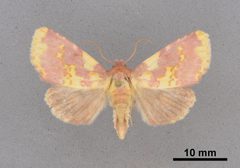
Psectrotarsia hebardi is a small noctuid in the Heliothinae, described by Skinner in 1917. It is known from a restricted range in the Appalachian region of the eastern United States. The refers to its larval association with stoneroot (Collinsonia canadensis).
Pronunciation
How to pronounce Psectrotarsia hebardi: /pˌsɛk.troʊˈtɑːr.siə hɛˈbɑr.di/
These audio files are automatically generated. While they are not always 100% accurate, they are a good starting point.
Identification
The small size (29–33 mm wingspan) and late summer period (August–September) may aid identification within its limited geographic range. Separation from requires examination of genitalic characters per Pogue (2007).
Images
Appearance
have a wingspan of 29–33 mm. Specific coloration and pattern details are not documented in available sources.
Habitat
Associated with mesic deciduous forests where the larval plant Collinsonia canadensis occurs. Specific requirements for are not documented.
Distribution
Known from northwestern New Jersey, southern Ohio, and western Virginia in the eastern United States. Records are sparse, with only one observation documented in iNaturalist.
Seasonality
are active from August to September. Larval is not documented.
Diet
Larvae have been recorded feeding on Collinsonia canadensis (stoneroot, Lamiaceae). feeding habits are not documented.
Host Associations
- Collinsonia canadensis - larval Lamiaceae; also known as stoneroot or richweed
Life Cycle
Complete with , larval, pupal, and stages. Specific details of development duration or stage are not documented.
Ecological Role
As a herbivore, larvae likely contribute to nutrient cycling through consumption of Collinsonia canadensis foliage. The may serve as prey for and , though specific interactions are not documented.
Human Relevance
No documented economic or cultural significance. The is of potential interest to lepidopterists due to its restricted range and specialized association.
Similar Taxa
- Psectrotarsia euposisCongeneric ; requires dissection and examination of genitalic structures for reliable separation per Pogue (2007) revision
- Other Heliothinae members share general ; precise identification requires reference to Pogue (2007) and geographic range consideration
More Details
Taxonomic revision
The Psectrotarsia was revised by Michael G. Pogue in 2007 (Zootaxa 1637), which provides the definitive modern treatment for identification.
Data deficiency
The is poorly known, with minimal observational records and undocumented larval and pupal .