
Marimatha
Walker, 1866
Lemon Moths
Species Guides
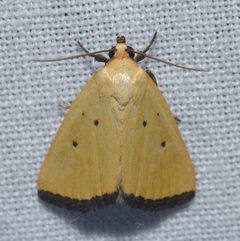
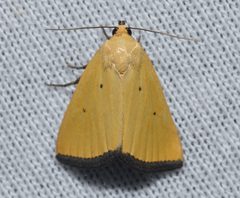
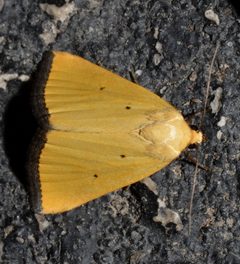
5- Marimatha nigrofimbria(Black-bordered Lemon Moth)
- Marimatha piscimala(Brown-lined Lemon Moth)
- Marimatha quadrata
- Marimatha squala
- Marimatha tripuncta(Three-spotted Lemon Moth)
Marimatha is a of noctuid in the Acontiinae, erected by Francis Walker in 1866. within this genus are distributed across the Americas, from the southern United States through Central America and into Brazil. The genus includes the Black-bordered Lemon Moth (M. nigrofimbria), which has been documented as a regular visitor to residential yards in the Midwestern United States.
Pronunciation
How to pronounce Marimatha: /ˌmɛɹɪˈmæθə/
These audio files are automatically generated. While they are not always 100% accurate, they are a good starting point.
Identification
-level identification in Marimatha often requires examination of genitalia or other subtle morphological features. M. nigrofimbria can be recognized by its yellow wings with dark borders. Several species were described relatively recently (2010) by Ferris & Lafontaine based on characters distinguishing them from previously described .
Images
Habitat
occur in diverse including residential yards, forested areas, and tropical regions. M. nigrofimbria has been observed in lawn and yard habitats in Kansas. M. piscimala, M. quadrata, and M. squala range through arid regions of Texas, Arizona, and Mexico.
Distribution
The ranges from the southern United States (including Vermont, Kansas, Texas, Arizona, Florida) through Mexico, Central America (Panama, Rica), and into Brazil (São Paulo, Bahia). Caribbean distribution includes Cuba, Puerto Rico, Dominican Republic, Haiti, Saint Croix, Virgin Islands, Trinidad, and the Antilles.
Seasonality
M. nigrofimbria has been documented as active during mid-summer (July) in Kansas. activity likely varies by and latitude across the broad geographic range.
Behavior
of at least M. nigrofimbria are attracted to light and have been observed resting on vegetation during daytime. They have been documented coming to blacklight setups, though some individuals may remain in shadows beyond direct illumination.
Human Relevance
M. nigrofimbria has become a familiar to amateur enthusiasts in the Midwestern United States, regularly appearing in residential moth surveys and National Moth Week observations. The serves as an example of tropical-subtropical moth diversity reaching into temperate North America.
Similar Taxa
- HypenaSimilar noctuid that can be found in similar and attracted to light; distinguished by different wing patterns and body shape
- Other Acontiinae generaClosely related noctuid requiring careful examination for generic placement
More Details
Taxonomic history
The was established by Francis Walker in 1866. Significant revision occurred in 2010 when Ferris & Lafontaine described three new (M. piscimala, M. quadrata, M. squala) from the southwestern United States and Central America, clarifying boundaries with related .