
Ogdoconta cinereola
(Guenée, 1852)
Common Pinkband, Common Pinkband Moth
Ogdoconta cinereola is a small noctuid commonly known as the Common Pinkband Moth. It is distinguished by the pinkish suffusion on the forewing subterminal region, which gives the its . The species is broadly distributed across eastern, central, and southwestern North America, with active from spring through fall depending on latitude. Larvae feed on a diverse range of plant .
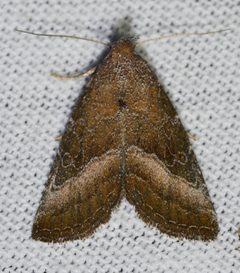
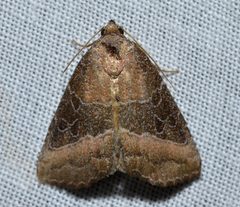
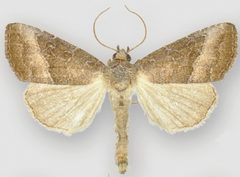
Pronunciation
How to pronounce Ogdoconta cinereola: /ˌɒɡdəˈkɒntə sɪˌnɛriˈoʊlə/
These audio files are automatically generated. While they are not always 100% accurate, they are a good starting point.
Identification
The pinkish subterminal band on the forewing is diagnostic and separates this from other Ogdoconta. The combination of: (1) pink suffusion in subterminal region, (2) white, nearly straight oblique postmedial line with slight basal bend, and (3) absence of claviform spot distinguishes O. cinereola from . The obscure but white-outlined and spots are useful secondary characters.
Images
Appearance
Small with forewing length 9.5–14.5 mm. Forewing light fuscous brown with subterminal region suffused with pinkish tinge. Medial and basal areas minutely speckled with white. Antemedial line an obscure, scalloped white line. and spots obscure but often discernible by fine white outlines. Claviform spot absent. Postmedial line white, almost straight and oblique with slight basally directed bend. Subterminal line marked primarily as brown shade terminating pink suffusion. Hindwings suffused with brown, darker in females than males.
Habitat
Occurs in open including grasslands, prairies, agricultural areas, and disturbed sites. Associated with areas supporting larval plants from multiple plant .
Distribution
Eastern, central, and southwestern North America. Range extends from southern Ontario and Quebec south to southern Florida, westward through Manitoba and the Great Plains (Nebraska, Iowa) to most of Texas, southern New Mexico, and southeastern Arizona (Santa Cruz County). Southern limit in northern Mexico (Coahuila).
Seasonality
active May–September in northern range; April–October in Texas and Florida. Extended period suggests multiple , though this has not been explicitly documented.
Diet
Larvae feed on in Amaranthaceae, Asteraceae (especially Ambrosia), Fabaceae, Lamiaceae, and Poaceae.
Host Associations
- Ambrosia - larval Asteraceae; especially noted as
Ecological Role
Larval herbivore; on diverse plant . Specific ecological functions (pollination, prey base) have not been documented.
Human Relevance
Occasionally encountered in agricultural settings due to larval feeding on crop-associated plant . Not considered a significant pest. Attracted to artificial light.
Similar Taxa
- Other Ogdoconta speciesLack pink subterminal suffusion; postmedial line shape and spot patterns differ
More Details
Taxonomic History
Originally described as Placodes cinereola by Guenée in 1852; later transferred to Ogdoconta.
Observation Frequency
Well-represented in citizen science platforms with over 5,600 observations on iNaturalist, indicating it is frequently encountered and readily identifiable by its distinctive wing pattern.