Alypia ridingsii
Grote, 1864
Ridings' Forester, Mountain Forester
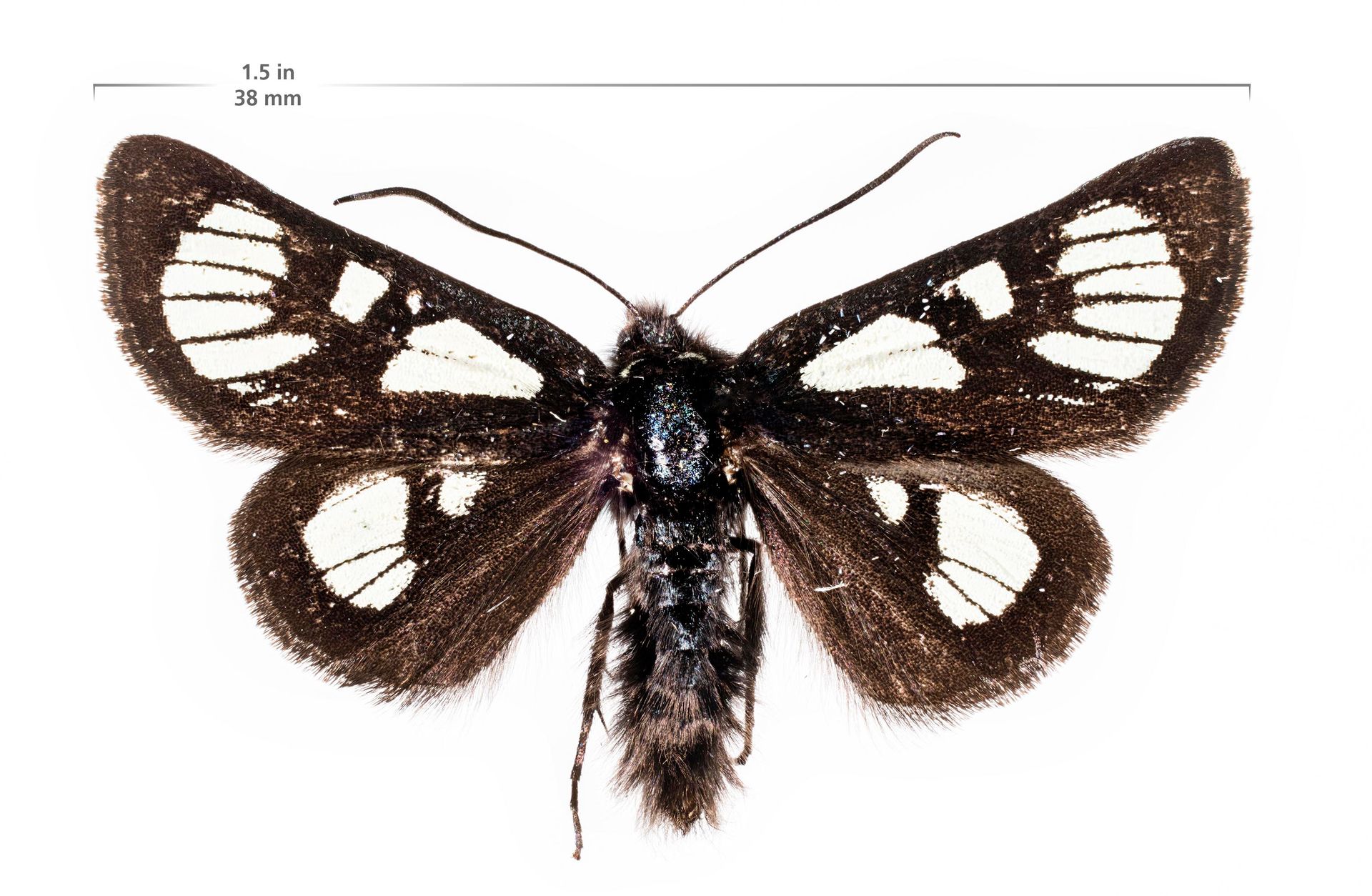
Alypia ridingsii, commonly known as Ridings' Forester or Mountain Forester, is a noctuid native to western North America. The was first described by Augustus Radcliffe Grote in 1864 and is named after James Ridings. are and display striking coloration, with a wingspan of approximately 30 mm. The species occurs from Alaska southward through western Canada and the western United States to California and eastward to Colorado.
Pronunciation
How to pronounce Alypia ridingsii: /əˈlɪpiə raɪˈdɪŋzi.aɪ/
These audio files are automatically generated. While they are not always 100% accurate, they are a good starting point.
Identification
Alypia ridingsii can be distinguished from other Alypia by its geographic range, which extends further north into Alaska and British Columbia than its . The species is , unlike many noctuids. Within the Alypia, it may be separated from the more eastern A. octomaculata (Eight-spotted Forester) by distribution, with A. ridingsii occurring west of the Rocky Mountains and A. octomaculata primarily in eastern North America.
Images
Distribution
Western North America from Alaska and British Columbia south through Washington, Oregon, Idaho, California, Nevada, Utah, Arizona, and east to the eastern edge of the Rocky Mountains in Colorado.
Seasonality
are on wing from March to May in California, with activity extending into June in more northern and eastern portions of the range.
Diet
Larvae feed on Camissonia bistorta, Camissonia californica, Camissonia dentata, and Clarkia rhomboidea.
Behavior
are (day-flying), which is unusual for a noctuid .
Similar Taxa
- Alypia octomaculataSimilar colorful noctuid in the same , but A. octomaculata occurs primarily in eastern North America while A. ridingsii is western