
Polygrammate hebraeicum
Hübner, 1818
Hebrew Moth, Hebrew
Polygrammate hebraeicum, commonly known as the Hebrew , is a noctuid moth native to eastern North America. It is recognized by distinctive dark markings on its wings that resemble Hebrew characters, giving rise to its . The species ranges from Ontario south to Florida and west to Texas, with active during the warmer months. Despite its distinctive appearance, detailed information remains limited.
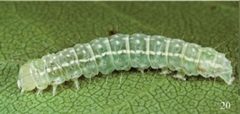
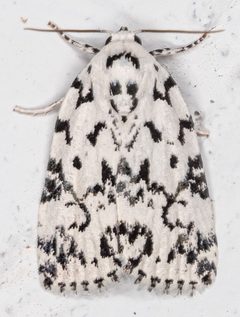
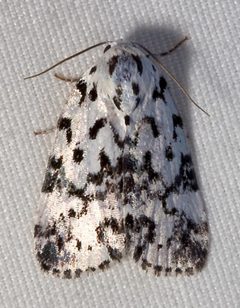
Pronunciation
How to pronounce Polygrammate hebraeicum: //ˌpɒlɪˈɡræmət ˌhiːˈbreɪɪkəm//
These audio files are automatically generated. While they are not always 100% accurate, they are a good starting point.
Identification
The Hebrew is readily identified by its pale forewings marked with bold, irregular dark brown to black patterns that resemble calligraphic script. This pattern is unique among North American noctuids and unlikely to be confused with other . The pale hindwings and moderate size further distinguish it from similar-sized noctuids with more uniform wing coloration. Specimens with worn wings may be more difficult to identify, but the general wing shape and body proportions remain distinctive.
Images
Habitat
Deciduous and mixed forests, woodlands, and forest edges. are attracted to light and may be found in suburban areas with mature trees. Larval requirements are poorly documented but likely associated with hardwood trees.
Distribution
Eastern North America: Ontario and Quebec south to Florida, west to Texas and Oklahoma. Core range in the eastern deciduous forest biome, with scattered records westward.
Seasonality
fly from late spring through summer, with peak activity in June and July in most of the range. Multiple may occur in the southern part of the range; single generation in the north.
Behavior
are and strongly attracted to light sources. They are not known to visit flowers or other food sources as adults. Larval is undocumented in published sources.
Ecological Role
serve as prey for including bats and night-foraging birds. Larval ecological role is unknown due to lack of documented plant relationships.
Human Relevance
Occasional visitor to porch lights and surveys; of interest to lepidopterists due to its distinctive appearance. No economic significance.
Similar Taxa
- Acronicta spp.Some dagger moths share pale ground color and dark markings, but lack the distinctive 'Hebrew character' pattern; markings are more linear or streaky rather than calligraphic.
- Balsa tristrigellaThree-lined balsa moth has pale wings with dark lines, but pattern consists of straight, parallel lines rather than irregular blotchy markings.
More Details
Etymology
The specific epithet 'hebraeicum' and 'Hebrew' refer to the resemblance of the wing markings to Hebrew characters, a pattern noted by early naturalists.
Research Needs
The larval plant(s) and complete of this remain undocumented in scientific literature, representing a significant gap in knowledge for this otherwise well-known .