
Acronicta longa
Guenée, 1852
long-winged dagger moth
Acronicta longa is a North American noctuid commonly known as the long-winged dagger moth. The was first described by Achille Guenée in 1852. have a wingspan of 32–44 mm. Larvae feed on the foliage of several woody plant species including birch, oak, and willow.
Pronunciation
How to pronounce Acronicta longa: //ˌækrəˈnɪktə ˈlɔŋɡə//
These audio files are automatically generated. While they are not always 100% accurate, they are a good starting point.
Identification
Distinguished from other Acronicta by its relatively elongated, narrow forewings. The specific epithet 'longa' refers to this wing shape. Similar species include other dagger moths in the Acronicta, which typically have broader, more rounded forewings. Definitive identification may require examination of genitalia or dissection.
Images
Appearance
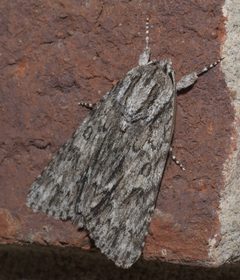
have a wingspan of 32–44 mm. The forewings are relatively long and narrow compared to other dagger moths, giving the its . Coloration is typically dull gray-brown with subtle patterning. The hindwings are paler. Larvae are not described in detail in available sources.
Habitat
Associated with deciduous forests and woodlands containing plants. Larvae have been recorded on birch, blackberry, oak, and willow, suggesting occupancy of mixed hardwood forests, riparian corridors, and scrub where these plants occur.
Distribution
Transcontinental in North America. Documented from Nova Scotia to Alberta in Canada, and south to Florida and Texas in the United States. GBIF records confirm presence in Alberta, Manitoba, and Saskatchewan in Canada, and Vermont in the United States.
Diet
Larvae feed on the foliage of birch (Betula spp.), blackberry (Rubus spp.), oak (Quercus spp.), and willow (Salix spp.). feeding habits are not documented in available sources.
Host Associations
- Betula - larval food plantbirch
- Rubus - larval food plantblackberry
- Quercus - larval food plantoak
- Salix - larval food plantwillow
Ecological Role
Larval herbivore on woody deciduous plants. Contributes to nutrient cycling through foliar consumption. May serve as prey for and other natural enemies, though specific interactions are not documented.
Similar Taxa
- Acronicta americanaSimilar (American dagger ) and general appearance, but A. americana has broader forewings and larvae are associated with different plants including maple and box elder.
- Acronicta radcliffeiAnother North American dagger with similar size and coloration; distinguished by wing shape and pattern details.
More Details
Taxonomic Note
Acronicta longa is the type for the concept of 'Long-winged Dagger and Allies' used in some taxonomic databases, though this appears to be an informal grouping rather than a formally recognized clade.
Sources and further reading
- BugGuide
- Wikipedia
- GBIF taxonomy match
- iNaturalist taxon
- NCBI Taxonomy
- Catalogue of Life
- New Guide Details Pest-Management Practices for Longan
- Megalopygidae | Beetles In The Bush
- Irradiation Can Be an Alternative to Fumigation
- Bug Eric: How to Catch a Leafroller Caterpillar (Video)
- Bug Eric: New Mexico Dragonfly Blitz - Day 4
- Glorious Earthworms - Buglife Blog - Buglife