
Acronicta hasta
Guenée, 1852
forked dagger moth, speared dagger moth, cherry dagger moth, dart dagger moth
Acronicta hasta is a noctuid native to eastern North American deciduous woodlands. have a wingspan of 35–45 mm and are active from April to September, with multiple in southern portions of the range. The was first described by Achille Guenée in 1852; Acronicta furcifera was synonymized with it in 1998. Three are recognized: A. h. hasta, A. h. telum, and A. h. manitoba.
Pronunciation
How to pronounce Acronicta hasta: /əˈkroʊnɪktə ˈhæstə/
These audio files are automatically generated. While they are not always 100% accurate, they are a good starting point.
Identification
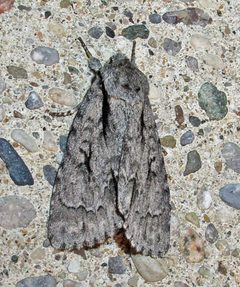
The prominent dark 'dagger' streak near the forewing apex distinguishes this from similar gray noctuids. The combination of size (35–45 mm wingspan), gray coloration with variable dark patterning, and the characteristic forewing mark separates it from . Acronicta radcliffei, found in similar , has different forewing markings.
Images
Appearance
have a wingspan of 35–45 mm. Forewings are grayish with variable dark markings; the 'speared dagger' refers to the distinctive dark streak or 'dagger' mark near the wing apex. Hindwings are pale gray to whitish.
Habitat
Eastern deciduous woodlands, including oak-hickory forests and areas with trees. Found in both mature forest and restored prairie remnants with nearby wooded edges.
Distribution
North America: eastern deciduous woodlands from the Atlantic coast west across southern Saskatchewan and Alberta to central southern British Columbia; south to Tennessee, Wisconsin, and Kansas.
Seasonality
active April to September depending on location. Two or more per year in the south; one or two generations in the north.
Diet
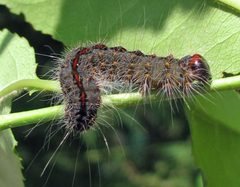
Larvae feed on cherry (Prunus), oak (Quercus), and plum (Prunus).
Host Associations
- Prunus serotina - larval black cherry
- Quercus spp. - larval oak
- Prunus spp. - larval plum and related
Life Cycle
Multiple per year in southern range (two or more), fewer in north (one or two). stage not specified in available sources.
Ecological Role
Larval herbivore on deciduous hardwood trees; contributes to nutrient cycling in forest . are and attracted to ultraviolet light.
Human Relevance
Minor potential significance as a defoliator of cherry and plum in orchards, though not considered a major pest. are collected by light-trapping entomologists.
Similar Taxa
- Acronicta radcliffeiSimilar gray noctuid dagger found in eastern deciduous forests; distinguished by different forewing pattern and markings
- Acronicta furciferaFormerly considered a separate , now synonymized with A. hasta based on 1998 revision
More Details
Taxonomic history
Acronicta furcifera was treated as a distinct until 1998, when it was synonymized with A. hasta. The A. h. manitoba is recognized from western Canada.