
Spragueia apicalis
(Herrich-Schäffer, 1868)
Yellow Spragueia Moth
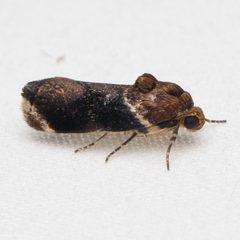
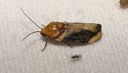
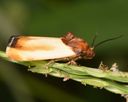
Spragueia apicalis is a small noctuid commonly known as the Yellow Spragueia Moth. exhibit in size, with males slightly larger than females. The has a broad distribution across the Americas, from the southern United States through Central America to South America. Larvae have been documented feeding on Gutierrezia sarothrae, a species of snakeweed.
Pronunciation
How to pronounce Spragueia apicalis: /sprəˈɡeɪ.jə əˈpɪ.kə.lɪs/
These audio files are automatically generated. While they are not always 100% accurate, they are a good starting point.
Identification
Distinguished from similar Spragueia by specific wing pattern and coloration; precise diagnostic features require examination of genitalia or detailed wing pattern analysis. Small size and yellow coloration are field marks, though confirmation typically requires reference to specialized noctuid literature.
Images
Habitat
Associated with supporting its larval plant Gutierrezia sarothrae, which occurs in dry, open areas including prairies, grasslands, and disturbed sites.
Distribution
North America: Alabama, Arkansas, Florida, Georgia, Illinois, Kansas, Kentucky, Louisiana, Maryland, Mississippi, Missouri, North Carolina, Ohio, Oklahoma, South Carolina, Tennessee, and Texas. Central America: El Salvador, Rica. Caribbean: Cuba. South America: Peru.
Diet
Larvae feed on Gutierrezia sarothrae (broom snakeweed). feeding habits not documented.
Host Associations
- Gutierrezia sarothrae - larval plantRecorded larval food source
Ecological Role
Herbivore as larva; specific functions not documented. Potential role in nutrient cycling through herbivory on Gutierrezia.
Human Relevance
No documented economic or medical significance. Occasionally encountered by enthusiasts and researchers.
Similar Taxa
- Other Spragueia speciesCongeneric share similar size range and general ; identification requires detailed examination of wing patterns and genitalia.
More Details
Taxonomic history
First described by Gottlieb August Wilhelm Herrich-Schäffer in 1868. The has been relatively well-collected across its range, with 533 observations recorded on iNaturalist as of source date.