
Dinumma deponens
Walker, 1858
curved-ribbon
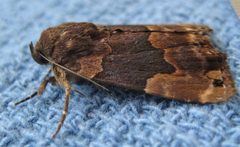
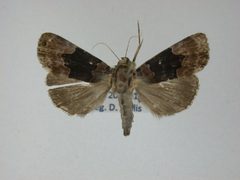
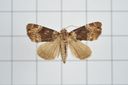
Dinumma deponens is a in the Erebidae (formerly Noctuidae) first described by Francis Walker in 1858. Native to Asia, it has been introduced to North America with established in the southeastern United States. The is notable for its larvae's ability to escape drowning through specialized undulatory locomotion on water surfaces. Larvae feed on Albizia species, particularly Albizia julibrissin.
Pronunciation
How to pronounce Dinumma deponens: /dɪˈnʊmə dɪˈpoʊnɛns/
These audio files are automatically generated. While they are not always 100% accurate, they are a good starting point.
Images
Habitat
Terrestrial; larvae associated with plants growing near wetland edges. Larvae have been observed on pond water surfaces when accidentally fallen from vegetation.
Distribution
Native range: India, eastern China, Japan, Korea, and Thailand. Introduced to North America: recorded from Fannin County, northern Georgia, USA (2012).
Diet
Larvae feed on leaves of Albizia julibrissin (Fabaceae).
Host Associations
- Albizia julibrissin - larval food plantFabaceae; primary documented in Japan
Behavior
Larvae exhibit undulatory on water surfaces: rapid side-to-side body swinging generates propulsion without use of thoracic legs. This behavior has been observed to aid escape from drowning and aquatic such as water striders. Propulsion is driven by rapid abdominal movements.
Ecological Role
Larvae serve as prey for aquatic including water striders when on water surfaces; potential prey resource for fish.
More Details
Taxonomic note
This was historically placed in Noctuidae but is now classified in Erebidae ( Calpinae) based on modern molecular and morphological studies.
Aquatic locomotion research
Undulatory was documented through experimental observations of 49 larvae under laboratory conditions and field observations in Unnan, Shimane Prefecture, Japan, in July 2018. Video analysis confirmed thoracic legs are not used during water surface propulsion.