
Redectis pygmaea
Grote, 1878
Pygmy Redectis Moth, pygmy redectis
Redectis pygmaea, described by Augustus Radcliffe Grote in 1878, is a small litter moth in the Erebidae. It is one of the smallest members of its , with a wingspan of approximately 14 mm. The is found in the eastern and south-central United States, where are active during summer months. It belongs to the Herminiinae, a group commonly known as litter moths due to their association with decaying plant material.
Pronunciation
How to pronounce Redectis pygmaea: //rɛˈdɛktɪs pɪɡˈmiːə//
These audio files are automatically generated. While they are not always 100% accurate, they are a good starting point.
Identification
The extremely small size (wingspan ~14 mm) distinguishes this from most other Redectis species. It may be separated from similar small Herminiinae by geographic range and period, though precise diagnostic characters require examination of genitalia or detailed wing pattern analysis. The specific epithet 'pygmaea' (meaning dwarf or pygmy) directly references its diminutive stature relative to .
Images
Appearance
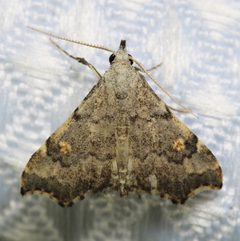
A very small with a wingspan of approximately 14 mm. As a member of the Herminiinae , it likely exhibits the typical litter moth with relatively broad wings and a compact body, though specific coloration and pattern details are not well documented in available sources.
Habitat
Associated with litter moth , which typically include forest floors, woodland edges, and areas with accumulated decaying plant material. Specific microhabitat preferences for this are not well documented.
Distribution
Eastern and south-central United States, ranging from New York south to Florida and westward to Texas.
Seasonality
are on wing from June to September, with peak activity during mid-summer months.
Ecological Role
As a litter moth, likely contributes to nutrient cycling through association with decaying organic matter, though specific ecological functions are not documented.
Similar Taxa
- Other Redectis speciesLarger size; R. pygmaea is distinguished by its notably smaller wingspan (~14 mm versus typically larger in )
More Details
Taxonomic history
Described by Augustus Radcliffe Grote in 1878, a prominent 19th-century American entomologist known for his work on North American Lepidoptera.
Etymology
The specific epithet 'pygmaea' derives from the Latin 'pygmaeus' meaning dwarf or pygmy, referencing the ' exceptionally small size.
Sources and further reading
- BugGuide
- Wikipedia
- GBIF taxonomy match
- iNaturalist taxon
- NCBI Taxonomy
- Catalogue of Life
- Tiny Insect, Big Questions: Is the World's Smallest Dragonfly Splitting Into Two Species?
- A suitable ode to Warren Knaus | Beetles In The Bush
- Surveying for the Maerdy Monster Millipede - Buglife Blog - Buglife
- Cynnal arolygon Miltroed Anghenfil y Maerdy - Buglife Blog - Buglife
- Glorious Earthworms - Buglife Blog - Buglife
- Arctic botany amongst the fjords