
Phyprosopus callitrichoides
Grote, 1872
Curve-lined Owlet, Curved-lined Owlet
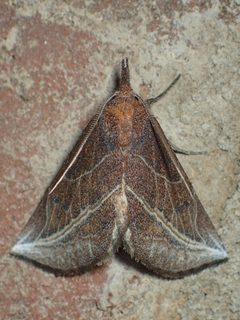
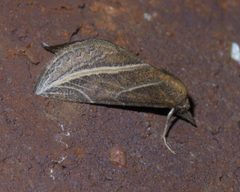
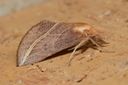
Phyprosopus callitrichoides is a North American in the Erebidae. have a wingspan of 28–35 mm and are active from May to August. The is notable for its distinctive larval , which has been described as "fantastically bizarre." Larvae feed on greenbrier (Smilax species).
Pronunciation
How to pronounce Phyprosopus callitrichoides: /faɪprəˈsoʊpəs ˌkælɪtrɪˈkoɪdiːz/
These audio files are automatically generated. While they are not always 100% accurate, they are a good starting point.
Identification
The specific epithet "callitrichoides" references resemblance to Callitrichia, a of jumping spiders, possibly alluding to cryptic appearance. can be recognized by the curved wing lines referenced in . Distinguished from other Phyprosopus by geographic range and wing pattern details; precise diagnostic features require examination.
Images
Habitat
Associated with supporting greenbrier (Smilax) , including woodlands, forest edges, and scrubby areas. Specific microhabitat preferences for not documented.
Distribution
Eastern and central United States: from New Hampshire south to Florida, west to Montana and Texas. Absent from Pacific coastal states and most of the Intermountain West.
Seasonality
on wing May to August. Single or multiple not clearly established; larval undocumented.
Diet
Larvae feed on greenbrier (Smilax). feeding habits not documented.
Host Associations
- Smilax - larval food plantgreenbrier
Life Cycle
Complete : , larva, pupa, . Detailed developmental stages and timing not documented. stage unknown.
Behavior
, attracted to light. Larval includes feeding on Smilax foliage; specific behavioral adaptations of the "fantastically bizarre" larval form not described.
Ecological Role
Herbivore as larva, consuming Smilax foliage. Role in as prey for not documented. No known specialized ecological functions.
Human Relevance
No economic importance. Occasionally encountered by naturalists and enthusiasts. Subject of interest due to unusual larval .
Similar Taxa
- Other Phyprosopus speciesSimilar wing pattern and body form; require genitalia examination or geographic range for reliable identification.
- Other Erebidae in ErebinaeMany share brown coloration and wavy wing lines; precise identification requires reference to literature.
More Details
Taxonomic history
Originally described by Augustus Radcliffe Grote in 1872. placement has shifted: some sources list Noctuidae, but current classification places it in Erebidae ( Erebinae) following molecular and morphological revisions of Noctuoidea.
Etymology
Specific epithet "callitrichoides" derives from Greek "kallos" (beauty) + "thrix" (hair) + "-oides" (resembling), or alternatively references resemblance to the spider Callitrichia, suggesting mimicry or .