
Boryzops purissima
Dyar, 1910
A large erebid with striking white forewings marked by black, green, and yellow pattern elements. are active year-round in Florida with distinct seasonal peaks. The occurs from the southern United States through Mexico to Central America and the Caribbean.
Pronunciation
How to pronounce Boryzops purissima: /bɔːˈrɪzɒps pjuːˈrɪsɪmə/
These audio files are automatically generated. While they are not always 100% accurate, they are a good starting point.
Identification
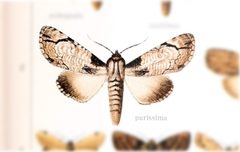
Distinguished from other Boryzops by the specific arrangement of green and yellow patches beyond the outer line on a grey waved ground, combined with the broken black outline and the distinctive hindwing pattern of pale brown with broad blackish margin. The combination of white forewing ground color with green and yellow accents is diagnostic within its range.
Images
Appearance
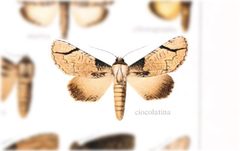
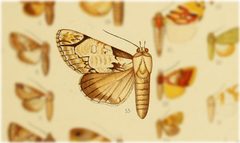
Wingspan approximately 68 mm. Forewings white with complex black, yellow-green, and grey markings. Basal costal black patch covers inner line; yellow-green below, black mark above inner margin with green scaling. Inner line narrow, single, black, bent inward below 1. line reduced to two grey costal marks. spot a black dot; brokenly outlined in black. Outer line thick, oblique to vein 5, with bar to outer margin. Beyond outer line: patches of green and yellow scales on grey strongly waved line continuing to costa. Terminal space with wavy brown shade and black line forming vein dentations. Hindwings pale brown with broad blackish marginal band, grey-powdered termen, and black line edged with white from near anal angle.
Distribution
Southern United States (Florida, Texas), Mexico (Veracruz), Rica, and Jamaica.
Seasonality
active January, March–August, and October–December in Florida, indicating year-round activity with reduced presence in February and September.