
Spiloloma lunilinea
Grote, 1873
Moon-lined Moth


Pronunciation
How to pronounce Spiloloma lunilinea: /ˌspɪloʊˈloʊmə ˌluːnɪˈlaɪniə/
These audio files are automatically generated. While they are not always 100% accurate, they are a good starting point.
Identification
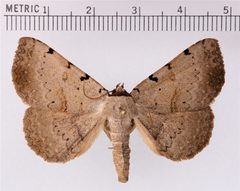
The moon-lined is distinguished from similar brown erebid moths by the prominent, pale, curved transverse line on the forewing—often appearing as a crescent or arc. This marking is usually more distinct than the wavy or straight lines found in related such as Catocala or Zale. The pale hindwings with a dark terminal band separate it from underwing moths (Catocala), which have boldly patterned hindwings. Compared to other Spiloloma (if any occur sympatrically), S. lunilinea is the primary documented species in its range.
Images
Appearance
Medium-sized with forewings marked by a distinctive pale, curved or crescent-shaped line (the 'moon line') against darker ground color. Forewing ground color ranges from brown to grayish-brown. Hindwings are pale, often whitish or light gray, with a darker terminal band. Body is moderately robust with typical erebid moth proportions.
Habitat
Deciduous and mixed forests, woodland edges, and adjacent open areas. are frequently attracted to artificial light sources in suburban and rural settings near forested .
Distribution
Eastern and south-central North America. Documented from the northeastern United States west to the Great Plains and south to Texas and the Gulf Coast states.
Seasonality
have been observed from late spring through early autumn, with peak activity during summer months. Specific period varies by latitude.
Behavior
are and strongly attracted to light. Larval and specific activity patterns remain undocumented in available sources.
Human Relevance
Subject of citizen science documentation through platforms such as iNaturalist. No known economic or agricultural significance.
Similar Taxa
- Catocala spp. (underwing moths)Similar forewing coloration and size, but underwing moths have boldly patterned hindwings (bands, spots, or bright colors) rather than the pale hindwings with simple dark terminal band of Spiloloma.
- Zale spp.Similar brown forewings and size, but Zale typically display more irregular, wavy, or multiple transverse lines rather than the single prominent curved pale line characteristic of S. lunilinea.
More Details
Taxonomic history
Described by Augustus Radcliffe Grote in 1873. The Spiloloma remains poorly studied, with S. lunilinea being the most frequently encountered and documented .
Data sources
Most occurrence records derive from citizen science platforms and light-trap collections; formal ecological study of this is limited.