
Catocala neogama euphemia
Beutenmüller, 1907
Catocala neogama euphemia is a of underwing in the Erebidae. It belongs to the Catocala, commonly known as underwing moths, which are characterized by their cryptic forewings that conceal brightly colored hindwings. The subspecies was described by Beutenmüller in 1907. Like other underwings, it is and attracted to light sources.
Pronunciation
How to pronounce Catocala neogama euphemia: //ˌkætoʊˈkeɪlə ˌniːoʊˈɡæmə juːˈfiːmiə//
These audio files are automatically generated. While they are not always 100% accurate, they are a good starting point.
Identification
Identification to level requires examination of hindwing coloration and pattern details, as well as forewing markings that may differ from the nominate subspecies C. n. neogama. The subspecies euphemia can be distinguished by specific differences in the banding and color intensity of the hindwings. Accurate identification typically requires comparison with reference specimens or detailed photographic documentation.
Images
Appearance
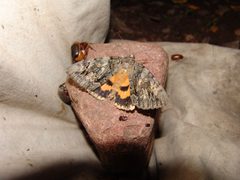
As a member of the Catocala, this possesses forewings with bark-like patterning that provides camouflage when at rest. When disturbed, it reveals brightly colored hindwings—typically orange, red, black, white, or blue markings that serve as a startle defense against . The specific coloration and pattern of C. n. euphemia distinguish it from other subspecies of C. neogama.
Habitat
Inferred from the -level of Catocala neogama and related underwing moths: associated with wooded where larval trees occur. are found in forests and woodlands, particularly near the host plants of their caterpillars.
Distribution
North America; specifically recorded from Vermont, United States. The occurs within the broader range of Catocala neogama, which is distributed across eastern North America.
Seasonality
are active during summer months. Based on related underwing , period likely occurs from June through August, with peak activity varying by latitude and local climate conditions.
Behavior
. are attracted to artificial light sources, including ultraviolet lights and mercury vapor lamps. When at rest during daylight hours, adults position themselves with forewings folded together over the back, concealing the brightly colored hindwings beneath. This posture provides effective camouflage against tree bark.
Ecological Role
may contribute to pollination through feeding activities. Larvae function as herbivores, consuming foliage of trees. Adults and larvae serve as prey for various including birds, bats, and insectivorous arthropods.
Human Relevance
Subject of interest among lepidopterists and enthusiasts, particularly during National Moth Week events and other citizen science initiatives. The striking appearance of underwing moths when their hindwings are exposed makes them popular photographic subjects and a gateway for public engagement with moth biodiversity.
Similar Taxa
- Catocala neogama neogamaNominate of the same ; distinguished by differences in hindwing banding and coloration intensity.
- Other Catocala speciesMany underwing moths share similar cryptic forewing patterns; accurate identification requires examination of hindwing color patterns and geographic distribution.
More Details
Taxonomic Note
The was described by William Beutenmüller in 1907. The name Catocala derives from Greek, meaning 'beautiful below,' referring to the concealed colorful hindwings.
Conservation Status
Not formally assessed; like many , trends and conservation status remain poorly documented.
Sources and further reading
- BugGuide
- GBIF taxonomy match
- iNaturalist taxon
- NCBI Taxonomy
- Catalogue of Life
- A Gathering of Lepidopterists: Who's Who of the Butterfly, Moth Experts | Bug Squad
- underwing moths | Beetles In The Bush
- Got Moths? Celebrate National Moth Week and Global Citizen Science
- Bug Eric: National Moth Week Recap, 2015
- Bug Eric: National Moth Week Recap for Colorado Springs
- Bug Eric: National Moth Week 2024 Recap from Kansas City