
Catocala herodias
Strecker, 1876
Herodias Underwing, Gerhard's Underwing
Species Guides
2- Catocala herodias gerhardi(Pine Barrens Underwing)
- Catocala herodias herodias(Herodias Underwing)
Catocala herodias is an underwing in the Erebidae, first described by Strecker in 1876. The comprises two with disjunct distributions: the nominate form occurs in Texas and Oklahoma, while subspecies C. h. gerhardi ranges from Massachusetts to Virginia. have a wingspan of 55–65 mm and fly from July to August. The gerhardi subspecies is listed as endangered in Connecticut.
Pronunciation
How to pronounce Catocala herodias: /kæˈtɒkələ hɛˈroʊdiəs/
These audio files are automatically generated. While they are not always 100% accurate, they are a good starting point.
Identification
Distinguished from other Catocala by geographic distribution and, for gerhardi, by its northeastern range. Identification to species level typically requires examination of genitalia or reference to regional keys, as many underwing moths exhibit similar cryptic forewing patterns. The two subspecies are separated by range: herodias in Texas and Oklahoma, gerhardi in the northeastern United States.
Images
Appearance
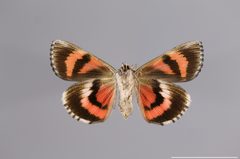
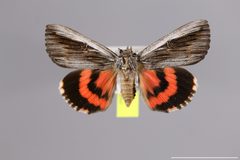
have a wingspan of 55–65 mm. Like other Catocala , the forewings are cryptically colored in muted browns and grays for camouflage against tree bark. The hindwings, concealed at rest, display bold coloration typical of underwing moths. Specific pattern details for C. herodias are not described in available sources.
Habitat
Associated with oak-dominated . The nominate occurs in Texas and Oklahoma. Subspecies gerhardi inhabits areas from Massachusetts, Connecticut, New York to Virginia, where it is associated with scrub oak habitats supporting its larval plants.
Distribution
North America. The nominate Catocala herodias herodias is found in Texas and Oklahoma. Subspecies Catocala herodias gerhardi occurs from Massachusetts, Connecticut, and New York south to Virginia. GBIF records confirm presence in North America.
Seasonality
are on wing from July to August, with timing varying by location. There is probably one per year.
Diet
Larvae feed on Quercus ilicifolia (scrub oak) and Quercus rubra (northern red oak). feeding habits are not documented in available sources.
Host Associations
- Quercus ilicifolia - larval scrub oak
- Quercus rubra - larval northern red oak
Life Cycle
Probably , with one per year. emerge in mid-summer. Complete details including , larval, and pupal stages are not documented in available sources.
Behavior
are . Like other underwing moths, they typically rest with forewings folded over the back, concealing the brightly colored hindwings. When disturbed, they may flash the hindwings to startle before taking . Underwing moths generally do not come readily to lights, or remain on the periphery of lighted areas.
Ecological Role
Larvae function as herbivores on oak . may serve as prey for including bats and birds. Specific ecological roles are not well documented.
Human Relevance
Catocala herodias gerhardi is listed as endangered in Connecticut, making it a of conservation concern in that state. The species is of interest to lepidopterists and enthusiasts, particularly during National Moth Week events.
Similar Taxa
- Other Catocala speciesMany underwing moths share similar cryptic forewing patterns and require careful examination or genitalia dissection for definitive identification. Geographic range is a key distinguishing feature for C. herodias.
- Catocala herodias gerhardi / C. h. herodiasThe two are distinguished by geographic range: gerhardi in the Northeast, herodias in Texas and Oklahoma. They may differ in minor morphological features, but subspecific identification relies primarily on locality.
More Details
Subspecies
Two recognized: Catocala herodias herodias Strecker, 1876 (Texas and Oklahoma) and Catocala herodias gerhardi Barnes & Benjamin, 1927 (Massachusetts to Virginia). The latter is endangered in Connecticut.
Etymology
The specific epithet herodias refers to Herodias, a figure from biblical and classical sources. The 'Gerhard's Underwing' honors the subspecific epithet gerhardi.
Sources and further reading
- BugGuide
- Wikipedia
- GBIF taxonomy match
- iNaturalist taxon
- NCBI Taxonomy
- Catalogue of Life
- A Gathering of Lepidopterists: Who's Who of the Butterfly, Moth Experts | Bug Squad
- Got Moths? Celebrate National Moth Week and Global Citizen Science
- Bug Eric: National Moth Week Recap, 2015
- Bug Eric: National Moth Week Recap for Colorado Springs
- Bug Eric: National Moth Week 2024 Recap from Kansas City
- Bug Eric: New Mexico Night Bugs