
Catocala hermia
Edwards, H., 1880
Hermia Underwing, Hermia's Underwing Moth
Species Guides
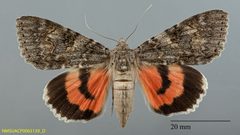
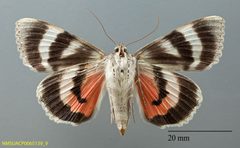
1Catocala hermia is an underwing in the Erebidae, first described by Henry Edwards in 1880. The is to the Great Plains of North America, ranging from southern Canada through the western United States. are active in late summer, and larvae feed on poplar and willow species. Like other underwing moths, it possesses cryptic forewings that conceal brightly patterned hindwings used in startle displays.
Pronunciation
How to pronounce Catocala hermia: /ˌkætəˈkɑːlə ˈhɜːrmiə/
These audio files are automatically generated. While they are not always 100% accurate, they are a good starting point.
Identification
Distinguished from other Catocala by its Great Plains distribution and association with Populus and Salix plants. The C. hermia francisca (often treated as a distinct species) occurs in the western portion of the range. Separation from similar underwing species requires examination of genitalia or detailed wing pattern analysis; specific diagnostic characters for C. hermia are not provided in available sources.
Images
Habitat
Associated with riparian and woodland supporting Populus and Salix throughout the Great Plains. Occurs in cottonwood groves, willow thickets, and mixed forests at various elevations, including dry mixed conifer forest with oaks at approximately 7,000 feet elevation.
Distribution
Great Plains of North America, from southern Saskatchewan and Alberta south and west through Texas, Arizona, and California. Distribution records confirm presence in Alberta, Manitoba, and Saskatchewan in Canada, and throughout the western United States.
Seasonality
are on wing from August to September, with exact timing varying by location. Larval stage presumably occurs earlier in the growing season, though specific is not documented.
Diet
Larvae feed on of Populus (poplars, cottonwoods) and Salix (willows). feeding habits are not documented.
Host Associations
- Populus - larval food plantPoplar and cottonwood
- Salix - larval food plantWillow
Life Cycle
Complete with , larva, pupa, and stages. Specific details of egg deposition, larval instars, site, or stage are not documented in available sources.
Behavior
are and attracted to light, though underwing moths typically remain on the periphery of light stations rather than landing directly on sheets. When disturbed, adults flash their brightly colored hindwings as a startle defense before taking . Normally rests with forewings held together over the back, concealing the hindwings.
Ecological Role
Larvae function as herbivores on riparian trees, potentially contributing to nutrient cycling and serving as prey for and . may serve as prey for predators including bats and spiders, and may contribute to pollination, though specific ecological roles are not documented.
Human Relevance
Subject of citizen science observation during National Week and similar events. Of interest to lepidopterists and moth enthusiasts. No documented economic importance as pest or beneficial .
Similar Taxa
- Catocala franciscaFormerly treated as C. hermia francisca; often now considered distinct . Occurs in western portion of C. hermia range, requiring careful examination for separation.
- Other Catocala speciesOver 250 in share cryptic forewing and colorful hindwing pattern; many require genitalia dissection or detailed wing venation and pattern analysis for reliable identification.
More Details
Taxonomic History
Originally described with two : C. hermia hermia and C. hermia francisca. The latter is now frequently treated as a distinct , rendering C. hermia . A third form, C. hermia verecunda, formerly recognized from Colorado, Montana, and Arizona, has been synonymized with C. hermia hermia.
Conservation Status
Not assessed by IUCN; appears to be relatively widespread within its range but with limited observation records (12 observations in iNaturalist as of source date).
Sources and further reading
- BugGuide
- Wikipedia
- GBIF taxonomy match
- iNaturalist taxon
- NCBI Taxonomy
- Catalogue of Life
- A Gathering of Lepidopterists: Who's Who of the Butterfly, Moth Experts | Bug Squad
- Got Moths? Celebrate National Moth Week and Global Citizen Science
- Bug Eric: National Moth Week Recap, 2015
- Bug Eric: National Moth Week Recap for Colorado Springs
- Bug Eric: National Moth Week 2024 Recap from Kansas City
- Bug Eric: New Mexico Night Bugs