
Catocala dulciola
Grote, 1881
Sweet Underwing, Quiet Underwing
Catocala dulciola, commonly known as the sweet underwing or quiet underwing, is a North American in the Erebidae. First described by Augustus Radcliffe Grote in 1881, this underwing moth exhibits the characteristic cryptic forewings and brightly patterned hindwings typical of its . The species has a documented wingspan of 40–45 mm and appears to have a single with active during early summer.
Pronunciation
How to pronounce Catocala dulciola: /kəˈtɒkələ dʌlˈsiːələ/
These audio files are automatically generated. While they are not always 100% accurate, they are a good starting point.
Identification
The specific identification features distinguishing C. dulciola from other Catocala are not documented in available sources. As with many underwing moths, definitive identification often requires examination of genitalia or detailed comparison of wing pattern elements with known specimens.
Images
Appearance
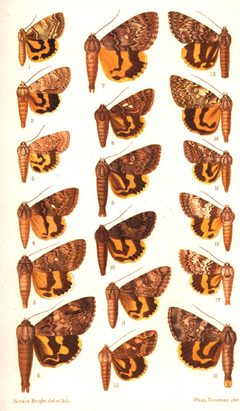
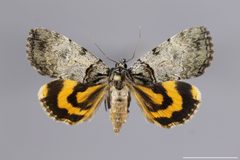
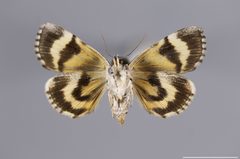
have a wingspan of 40–45 mm. Like other underwing moths, the forewings are dull-colored and serve as camouflage when the is at rest with wings folded. The hindwings, concealed at rest, display the bold coloration characteristic of the Catocala when exposed.
Distribution
Documented from the eastern and central United States, specifically from New York south through Virginia, west to Missouri, and north to Illinois and Michigan.
Seasonality
are on wing from June to July, with timing varying by location. There is probably one per year.
Diet
Larvae feed on Crataegus (hawthorn). feeding habits are not documented.
Host Associations
- Crataegus - larval food plantHawthorn serve as the documented larval .
Life Cycle
The includes , larval, pupal, and stages. Larvae feed on Crataegus. details and stage are not documented. There appears to be one annually.
Behavior
are . Like other Catocala , they typically do not come readily to lights or remain on the periphery of lighted areas when they do appear.
Similar Taxa
- Other Catocala speciesAll underwing moths share the characteristic of dull, cryptic forewings concealing brightly patterned hindwings. Differentiation requires detailed examination of wing patterns and often genitalia.
More Details
Taxonomic history
The was described by Augustus Radcliffe Grote in 1881. The Catocala, meaning 'beautiful below' in Greek, refers to the striking hindwing patterns hidden beneath the forewings at rest.
Sources and further reading
- BugGuide
- Wikipedia
- GBIF taxonomy match
- iNaturalist taxon
- NCBI Taxonomy
- Catalogue of Life
- A Gathering of Lepidopterists: Who's Who of the Butterfly, Moth Experts | Bug Squad
- Got Moths? Celebrate National Moth Week and Global Citizen Science
- Bug Eric: National Moth Week Recap, 2015
- Bug Eric: National Moth Week Recap for Colorado Springs
- Bug Eric: National Moth Week 2024 Recap from Kansas City
- Bug Eric: New Mexico Night Bugs