
Catocala connubialis
Guenée, 1852
Connubial Underwing
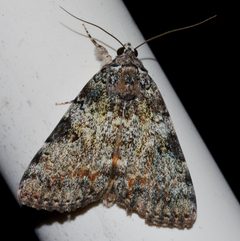
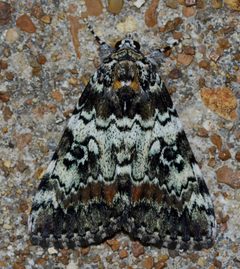
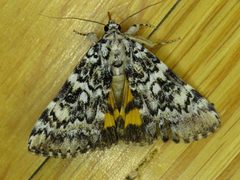
Catocala connubialis, the connubial underwing, is a in the Erebidae. It is a medium-sized underwing moth with a wingspan of 37–47 mm. The is distributed across eastern and central North America, from Ontario and the Maritime provinces south to Florida and west to Texas, Oklahoma, and Missouri. are active from June to September, with likely one per year.
Pronunciation
How to pronounce Catocala connubialis: /ˌkætoʊˈkeɪlə ˌkɒnjuˈbaɪəlɪs/
These audio files are automatically generated. While they are not always 100% accurate, they are a good starting point.
Identification
As an underwing in the Catocala, this possesses cryptic, bark-matching forewings that hide brightly colored hindwings. Specific identification to species level within Catocala requires examination of precise wing patterns, particularly the details of hindwing banding and forewing markings. Dissection of genitalia may be necessary for definitive identification, as many Catocala species are similar in appearance.
Images
Habitat
Associated with wooded supporting its larval plants, including areas with buttonbush (Cephalanthus occidentalis), chinaberry (Melia azedarach), and northern red oak (Quercus rubra). The has been recorded in dry mixed conifer forest with oaks at elevations around 7,000 feet.
Distribution
Eastern and central North America. Range extends from Ontario to Prince Edward Island, including Quebec, New Brunswick, and Nova Scotia, south to Florida, and west to Texas, Oklahoma, and Missouri.
Seasonality
are on wing from June to September, with timing varying by location. There is probably one per year.
Diet
Larvae feed on Cephalanthus occidentalis (buttonbush), Melia azedarach (chinaberry), and Quercus rubra (northern red oak). feeding habits are not documented.
Host Associations
- Cephalanthus occidentalis - larval buttonbush
- Melia azedarach - larval chinaberry
- Quercus rubra - larval northern red oak
Life Cycle
Likely (one per year). Detailed information including , larval instars, , and stage is not documented.
Behavior
are . Like other underwing moths, they typically rest with forewings folded over the back, concealing the brightly colored hindwings. When disturbed, they may flash the hindwings as a startle defense before taking . Underwing moths generally do not come readily to lights, or remain on the periphery of lighted areas.
Ecological Role
Larvae function as herbivores on their plants. likely serve as prey for including bats and birds. The contributes to the as both consumer and food source.
Human Relevance
Subject of interest to lepidopterists and citizen scientists participating in observation events such as National Moth Week. The is not known to be of economic importance.
Similar Taxa
- Other Catocala speciesMany underwing moths share the characteristic cryptic forewings and brightly patterned hindwings. Specific identification requires detailed examination of wing patterns and often genitalia dissection.
More Details
Sources and further reading
- BugGuide
- Wikipedia
- GBIF taxonomy match
- iNaturalist taxon
- NCBI Taxonomy
- Catalogue of Life
- A Gathering of Lepidopterists: Who's Who of the Butterfly, Moth Experts | Bug Squad
- Got Moths? Celebrate National Moth Week and Global Citizen Science
- Bug Eric: National Moth Week Recap, 2015
- Bug Eric: National Moth Week Recap for Colorado Springs
- Bug Eric: National Moth Week 2024 Recap from Kansas City
- Bug Eric: New Mexico Night Bugs