
Eublemma recta
Guenée, 1852
Straight-lined Seed Moth
Eublemma is a small in the Erebidae, first described by Achille Guenée in 1852. It occurs across the southeastern United States, the Caribbean, and extends south to Argentina. The has a wingspan of 16–19 mm. Larvae are specialized feeders on plants in the family Convolvulaceae.
Pronunciation
How to pronounce Eublemma recta: /juːˈblɛmə ˈrɛktə/
These audio files are automatically generated. While they are not always 100% accurate, they are a good starting point.
Identification
The specific epithet "" (Latin for "straight") and "straight-lined seed " suggest linear wing markings may be diagnostic, though detailed identification features are not documented in available sources. Small size and association with Convolvulaceae plants may aid recognition.
Images
Appearance
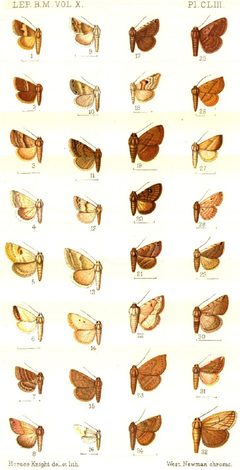
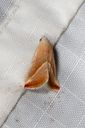
Small with wingspan of 16–19 mm. Wing pattern and coloration details are not specified in available sources.
Habitat
Occurs in regions supporting its larval plants in the Convolvulaceae, which includes morning glories and related vines. Specific preferences are not documented.
Distribution
Southeastern United States from South Carolina to Florida and west to Texas; Caribbean islands including Cuba, Jamaica, and Puerto Rico; southward through the Neotropics to Argentina.
Diet
Larvae feed on various plants in the Convolvulaceae, including Ipomoea and Convolvulus . feeding habits are not documented.
Host Associations
- Ipomoea - larval food plant of morning glories in Convolvulaceae
- Convolvulus - larval food plant of bindweeds in Convolvulaceae
Ecological Role
Larval herbivore on Convolvulaceae; specific ecological impacts are not documented.
More Details
Taxonomic History
Described by French entomologist Achille Guenée in 1852. The has been classified in Erebidae, though some sources (e.g., GBIF) historically placed it in Noctuidae, reflecting ongoing taxonomic revisions in the Noctuoidea.
Observation Data
The has been documented in 1,304 observations on iNaturalist, indicating it is moderately well-recorded by citizen scientists within its range.
Sources and further reading
- BugGuide
- Wikipedia
- GBIF taxonomy match
- iNaturalist taxon
- NCBI Taxonomy
- Catalogue of Life
- Glossary
- Soybean Insects: Early-to-Late Season Pests (Emergence to R7) - AgriLife Extension Entomology
- Terrible Night for a Visiting Scholar at UC Davis | Bug Squad
- Dry, Red Sticky Trap Improves Spotted-Wing Drosophila Monitoring
- 425-million-year-old Arthropod Found in England
- Bug Eric: Window-winged Moths