
Hypoprepia miniata
(Kirby, 1837)
Scarlet-winged Lichen Moth, Scarlet Lichen Moth
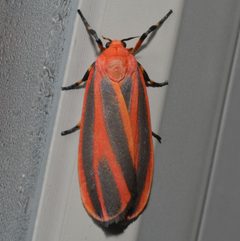
A small lichen with bright scarlet forewings marked by black bands. are active from spring through late summer depending on region, with western peaking in mid-summer and eastern populations appearing earlier and persisting longer. The was first described in 1837 and remains common across much of North America.
Pronunciation
How to pronounce Hypoprepia miniata: /ˌhaɪ.poʊˈpriː.pi.ə ˌmɪn.iˈeɪ.tə/
These audio files are automatically generated. While they are not always 100% accurate, they are a good starting point.
Identification
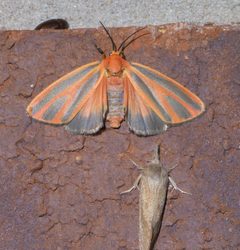
The combination of small size, scarlet-red forewings with black banding, and lichen body shape distinguishes this . Similar red-and-black patterned moths in the region include other Hypoprepia species and some Cisthene lichen moths, which tend to have more complex spotting patterns rather than clean transverse bands.
Images
Appearance
Forewings measure 14–17 mm in length. The forewings are bright scarlet red with bold black transverse bands. Hindwings are typically paler, often pinkish or yellowish. The body is relatively slender compared to some related tiger moths.
Habitat
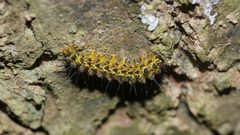
Associated with forested areas where lichen grows abundantly on tree bark, particularly pine stands. Larval is specifically the lichen-covered trunks and branches of trees.
Distribution
North America: British Columbia south through the western Rocky Mountains to Arizona and Texas; also throughout eastern North America from Canada to the southeastern United States. Canadian provincial records include Alberta, Manitoba, and Saskatchewan.
Seasonality
fly July to August in western ; April to September in eastern populations, with a considerably longer season.
Diet
Larvae feed on lichen growing on trees, with a preference for lichen on pines. feeding habits are not documented.
Host Associations
- lichen - larval foodgrowing on trees, preferably pines
Life Cycle
Overwinters in the larval stage. and timing varies by region, producing the observed differences in adult seasons between eastern and western .
Ecological Role
Larval grazing on lichen contributes to nutrient cycling in forest . The serves as prey for birds, bats, and other .
Human Relevance
Occasionally encountered by forest and hikers. No economic significance. Sometimes photographed by naturalists due to its bright coloration.
Similar Taxa
- Hypoprepia fucosaSimilar size and banded wing pattern, but with different coloration (more orange or yellow tones rather than scarlet)
- Cisthene speciesOther small lichen moths with bright warning coloration, but typically with spotted or mottled patterns rather than clean transverse bands
More Details
Subspecies
Two recognized: H. m. miniata and H. m. mississippiensis Barnes & Benjamin, 1926 (eastern form)