
Pygarctia roseicapitis
Neumoegen & Dyar, 1893
Red-headed Pygarctia Moth
Pygarctia roseicapitis is a tiger moth in the Erebidae, found in the southwestern United States and Mexico. are active from May to September and have forewings 14–17 mm in length. The is notable for producing acoustic warning signals to deter bat , a called acoustic aposematism. Larvae are on latex-rich Euphorbiaceae and exhibit distinctive trenching behavior—cutting leaf before feeding to reduce latex flow.

Pronunciation
How to pronounce Pygarctia roseicapitis: //pɪˈɡɑːrk.ti.ə roʊˌziː.kəˈpiːtɪs//
These audio files are automatically generated. While they are not always 100% accurate, they are a good starting point.
Identification
Distinguished from similar tiger moths by geographic range (southwestern North America) and association with Euphorbia plants. may be identified by the combination of red coloration and forewing length of 14–17 mm. The ' acoustic aposematism has been documented specifically in this , though this requires specialized equipment to detect.
Images
Habitat
Associated with latex-rich plants in the Euphorbiaceae, particularly Euphorbia . Found in arid and semi-arid regions of the southwestern United States and Mexico where these host plants occur.
Distribution
Mexico; United States from southern Arizona to Texas.
Seasonality
on wing from May to September.
Diet
Larvae feed on various Euphorbiaceae , specifically documented on Chamaesyce hyssopifolia (now often treated as Euphorbia hyssopifolia). do not feed.
Host Associations
- Chamaesyce hyssopifolia - larval food plantEuphorbiaceae; often treated as Euphorbia hyssopifolia
Life Cycle
Complete with , larval, pupal, and stages. Full-grown larvae reach approximately 30 mm before . Specific details of pupation site and stage are not documented.
Behavior
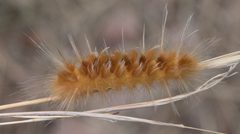
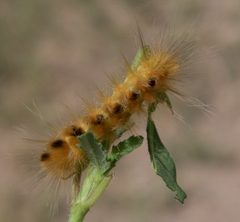
Larvae exhibit trenching : invariably cutting of plants, particularly petioles, before feeding to the cuts. This behavior reduces latex flow from the wounded plant. Larvae spend approximately 7% of their time in vein-cutting behavior and 40% feeding. Most vein-cutting occurs on petioles, allowing multiple feeding bouts on the resultant wilted leaf. Both leaves and plants are often abandoned before full resource utilization. produce acoustic warning signals (acoustic aposematism) to deter bat . Unlike most eared that consistently perform evasive dives when detecting bat echolocation, this shows variable evasive behavior—sometimes remaining relatively stationary ('nonchalance continuum'), suggesting reliance on warning signals rather than evasive maneuvers.
Ecological Role
Herbivore specializing on latex-rich Euphorbiaceae. The trenching represents a specific to overcome plant chemical defenses. As a tiger moth, it participates in acoustic -prey interactions with bats, contributing to documented cases of acoustic aposematism in natural .
Human Relevance
Subject of research on acoustic aposematism and the evolutionary arms race between and bats. The trenching has been studied as an example of behavioral to plant chemical defenses. No significant economic or agricultural impacts are documented.
Similar Taxa
- Other Pygarctia speciesShared characteristics; distinguished by specific geographic range, associations, and the red coloration implied by the
- Other tiger moths (Arctiinae)Many share acoustic signaling capabilities; P. roseicapitis specifically documented to produce acoustic aposematic signals and show variable evasive ('nonchalance continuum') compared to more consistently evasive
- Cisthene martiniAnother tiger moth studied alongside P. roseicapitis for acoustic aposematism; distinguished by -level differences and presumably different geographic range and associations
More Details
Research significance
This was one of two tiger moths specifically studied by Dowdy (2015) to demonstrate that acoustic aposematism occurs in natural , not just laboratory conditions. This was the first field documentation of the phenomenon.
Evolutionary context
Research on this supports the hypothesis that acoustic aposematism is the ancestral function of sound production in tiger moths, with sonar jamming evolving later in certain lineages.
Trenching behavior significance
The larval trenching on Euphorbia represents a specific to latex-rich plants. The observation that larvae abandon leaves and plants before full resource utilization suggests trade-offs in this foraging strategy, possibly related to declining food quality or increasing defense induction.