
Halysidota schausi
Rothschild, 1909
Schaus' tussock moth
Halysidota schausi is a tussock in the Erebidae, first described by Walter Rothschild in 1909. are primarily active during autumn. The species has a broad Neotropical distribution extending from the southern United States through Central America and into northern South America, with additional insular in the Caribbean.
Pronunciation
How to pronounce Halysidota schausi: /həˌlɪsɪˈdoʊtə ˈʃaʊsi/
These audio files are automatically generated. While they are not always 100% accurate, they are a good starting point.
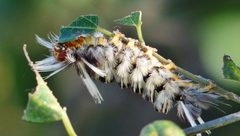
Images
Distribution
Found from Texas and Mexico southward through Rica, Guatemala, Colombia, Venezuela, Ecuador, and Peru. Also occurs on Martinique and the Lesser Antilles.
Seasonality
are mainly on wing in autumn.
Diet
Larvae feed on Cestrum nocturnum (night-blooming jasmine).
Host Associations
- Cestrum nocturnum - larval food plant
Similar Taxa
- Halysidota tessellarisSimilar banded tussock appearance; H. tessellaris occurs further north in eastern North America and has different larval plants including various hardwood trees
More Details
Taxonomic History
Originally described in the , which has been subsumed into Erebidae under modern classification systems.
Sources and further reading
- BugGuide
- Wikipedia
- GBIF taxonomy match
- iNaturalist taxon
- NCBI Taxonomy
- Catalogue of Life
- Megalopygidae | Beetles In The Bush
- Bug Eric: New Mexico Dragonfly Blitz - Day 3
- Bug Eric: National Moth Week 2024 Recap from Kansas City
- 🌿 Botanizing w/ the WGNSS Botany Group at Victoria Glades Preserve | Beetles In The Bush