
Euchaetes perlevis
Grote, 1882
Pronunciation
How to pronounce Euchaetes perlevis: //juːˈkeɪtiːz pɛrˈlɛvɪs//
These audio files are automatically generated. While they are not always 100% accurate, they are a good starting point.
Identification
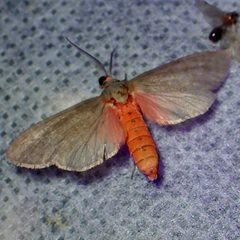
Euchaetes perlevis can be distinguished from other Euchaetes by its restricted distribution in Arizona, New Mexico, and Texas. Within this , identification to species level typically requires examination of genitalia and comparison with . The small size (wingspan ~23 mm) may help separate it from larger , though precise diagnostic features are not published in readily accessible sources.
Images
Distribution
Found in the southwestern United States, specifically in the states of Arizona, New Mexico, and Texas.
Similar Taxa
- Euchaetes egleA much better-known with extensive documentation; E. egle occurs across eastern and central North America, has larger larvae with distinctive orange, black, and white tufted setae, and feeds on milkweeds—traits that clearly distinguish it from the poorly known E. perlevis.
- Other Euchaetes speciesThe Euchaetes contains multiple in North America; most are poorly documented and require examination for reliable identification. Geographic range is the primary distinguishing feature for E. perlevis.
More Details
Taxonomic note
Euchaetes perlevis is one of many North American arctiine with minimal published biological data. The is better known through E. egle, the milkweed tussock moth, which has been extensively studied for its chemical defense and mimicry relationships. The scarcity of records for E. perlevis likely reflects genuine rarity, restricted , or undercollection rather than synonymy.
Research needs
Basic biological information— plants, larval , , and precise requirements—remain unknown for this . Museum collections and targeted field surveys in the southwestern U.S. would be needed to document its .
Sources and further reading
- BugGuide
- Wikipedia
- GBIF taxonomy match
- iNaturalist taxon
- NCBI Taxonomy
- Catalogue of Life
- Bugs in orange and black - Monarch butterfly, Danaus plexippus Milkweed Bug - Oncopeltus fasciatus; Milkweed tiger moth, Euchaetes egle — Bug of the Week
- Bugs in Orange and Black: Monarch Butterfly, Milkweed Leaf Beetle, Milkweed Bug, and Milkweed Tiger Moth — Bug of the Week
- Bug in orange and black: Milkweed tussock moth, Euchaetes egle, and its caterpillars have tricks but no treats for hungry predators — Bug of the Week
- The other monarch caterpillar: Milkweed tussock moth, Euchaetes egle — Bug of the Week
- Save some milkweed for me! Monarchs and the milkweed tussock moth, Euchaetes egle — Bug of the Week
- Gelechiidae | Beetles In The Bush