
Horama panthalon
(Fabricius, 1793)
Texas Wasp Moth
Species Guides
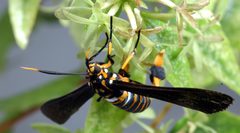
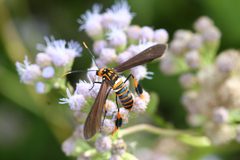
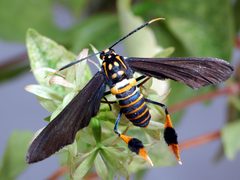
1Horama panthalon, commonly called the Texas , is a moth in the Arctiinae ( Erebidae) known for its striking mimicry of paper wasps. The was described by Fabricius in 1793 and occurs across a broad Neotropical and Nearctic range. are active year-round in warmer regions and possess a wingspan of 32–34 mm. The species exhibits , resembling Polistes wasps in coloration and as a defense against .
Pronunciation
How to pronounce Horama panthalon: /hɔˈraː.ma panˈtaː.lon/
These audio files are automatically generated. While they are not always 100% accurate, they are a good starting point.
Identification
Distinguished from true paper wasps (Polistes) by non-elbowed , lack of a constricted petiole waist, and resting posture with wings folded tent-like over body rather than folded lengthwise. Separated from other Horama by specific banding pattern and geographic range. identification requires examination of wing coloration and locality: H. p. texana in southwestern US and Mexico, H. p. panthalon in Caribbean and northern South America, H. p. viridifusca in southern South America.
Images
Habitat
Tropical and subtropical open including scrublands, forest edges, gardens, and urban areas where plants and mimicked occur. Associated with warm climates where can remain active year-round.
Distribution
Widespread in the Neotropics and southern Nearctic: South America (Brazil, Argentina, Bolivia, Paraguay), Central America, Mexico, the Antilles, and southern United States (Texas, Arizona, New Mexico, Florida). Presence confirmed across this range through multiple with distinct geographic distributions.
Seasonality
active year-round in tropical and subtropical portions of range; peak activity varies regionally with warm-season abundance in temperate southern US.
Behavior
are or , unusual for arctiine . is slow and hovering, closely mimicking the flight pattern of paper wasps. Mimicry includes both visual and behavioral components, with adults often visiting flowers. When disturbed, may wave and adopt defensive postures resembling threat displays.
Ecological Role
are of flowers. The mimicry provides protection from vertebrate that avoid stinging insects. Larval ecological role is undocumented in available sources.
Human Relevance
Occasionally noticed by observers due to conspicuous -like appearance, sometimes causing alarm before recognition as a harmless . No economic importance documented. Subject of interest in studies of mimicry and protective coloration.
Similar Taxa
- Polistes species (paper wasps)Visual mimic; distinguished by elbowed , narrow petiole waist, and different wing folding at rest
- Other Horama species share -mimicry ; require examination of banding patterns, wing shape, and geographic distribution for separation
- Syntomeida epilais (Polka-dot Wasp Moth)Another arctiine mimic with spotted rather than banded pattern; larger with iridescent blue-green spots on black background
More Details
Subspecies
Three recognized with non-overlapping ranges: H. p. panthalon (Caribbean, Panama, northern Colombia, Venezuela), H. p. texana (southwestern US, Mexico, Guatemala), and H. p. viridifusca (southern Brazil, northern Argentina, Bolivia, Paraguay). Subspecies differ primarily in wing coloration and intensity of body banding.
Taxonomic History
Originally described as Zygaena panthalon by Fabricius in 1793, later transferred to Horama. Classification shifted from to Arctiinae within Erebidae following molecular phylogenetic revisions of Noctuoidea.