
Horama
Hübner, 1819
Texas wasp moth (H. panthalon only)
Species Guides
2- Horama panthalon(Texas Wasp Moth)
- Horama plumipes
Horama is a of tiger moths in the Erebidae, established by Jacob Hübner in 1819. The genus contains approximately 11 recognized distributed primarily in the Americas, with notable diversity in the Caribbean region. Several species exhibit striking mimicry, most famously H. panthalon, known as the Texas wasp moth. The genus has undergone taxonomic revision, with some species formerly placed here reassigned to related genera such as Poliopastea.
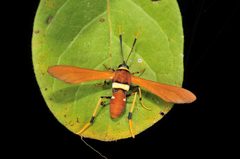
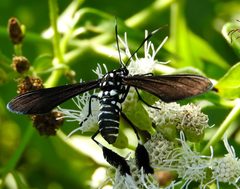
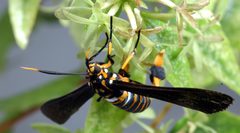
Pronunciation
How to pronounce Horama: //hɔˈɹɑːmə//
These audio files are automatically generated. While they are not always 100% accurate, they are a good starting point.
Identification
in Horama are distinguished from other tiger moths by their -like appearance, featuring narrow, elongated wings and a slender body with contrasting color patterns of black, orange, and yellow. The can be separated from the similar genus Poliopastea by genitalic characters and subtle differences in wing venation. Specific species identification requires examination of male genitalia and detailed wing pattern analysis; H. panthalon is particularly recognizable by its bold transverse orange bands on a black background.
Images
Distribution
The occurs from the southern United States (Texas and Florida) through Mexico, Central America, and the Caribbean islands, with the highest in the West Indies. Individual have more restricted ranges: H. panthalon is found from Texas to Florida and south through Mexico; H. margarita and H. rawlinsi are to the Caribbean.
Behavior
are and exhibit rapid, erratic patterns that enhance their resemblance to stinging , a form of . This wasp-mimicry serves as a defense against .
Human Relevance
The Texas wasp moth (H. panthalon) is frequently encountered and photographed due to its conspicuous appearance and daytime activity, making it a subject of interest for naturalists and photographers. No in the are known agricultural pests.
Similar Taxa
- PoliopasteaFormerly confused with Horama; distinguished by genitalic and reestablished as a separate in 1976
- SyntomeidaShares -mimicry and similar coloration; differs in wing shape and body proportions
More Details
Taxonomic History
The was reviewed by Dietz and Duckworth in 1976, resulting in the reestablishment of Poliopastea as a valid genus and clarification of boundaries. McCabe (1992) revised Caribbean species, describing two new species and documenting mimicry complexes.
Mimicry
Multiple Horama participate in Müllerian or rings with vespid , though the specific model species and evolutionary dynamics remain incompletely documented.