
Ctenucha brunnea
Stretch, 1872
Brown Ctenucha, Brown-winged Ctenucha
Ctenucha brunnea is a in the Erebidae, first described by Richard Harper Stretch in 1872. It is to coastal California, where it replaces the closely related Ctenucha multifaria in central to southern regions. are notable for their metallic blue bodies, red , and brown wings. The has a documented association with specific plants for both adult nectar feeding and larval development.
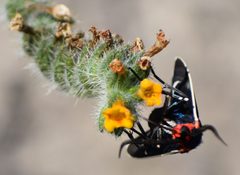
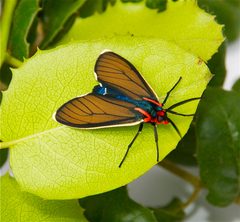
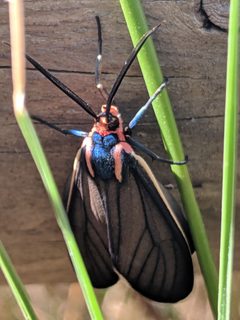
Identification
Distinguished from the sympatric Ctenucha multifaria by brown (not blue-black) forewings. The red and shoulder markings combined with metallic blue body separate it from most other Ctenucha . In northern California, C. multifaria replaces this species, with the transition zone in central coastal California.
Images
Habitat
Coastal California environments. observed feeding on Heteromeles arbutifolia (toyon). Larvae associated with Leymus condensatus (giant wild rye) and other grasses and sedges.
Distribution
to the United States: central to southern coastal California. Replaced by Ctenucha multifaria north of this range.
Seasonality
active mid-May to mid-July. Single period annually.
Diet
feed on nectar of Heteromeles arbutifolia. Larvae feed on Leymus condensatus and other grasses and sedges (Poaceae and Cyperaceae).
Host Associations
- Heteromeles arbutifolia - nectar sourceToyon; primary documented nectar plant
- Leymus condensatus - larval plantGiant wild rye; primary documented larval food plant
- Poaceae - larval plantGrasses generally
- Cyperaceae - larval plantSedges generally
Life Cycle
laid in rows, round, white fading to yellow. Larvae black with buff or yellow hairs, bearing two black tufts and amber-orange . Pupae chestnut-colored in loose cocoon of larval hairs. with May–July.
Behavior
activity pattern (unusual for Erebidae). visit flowers for nectar. Larvae feed on grasses and sedges.
Ecological Role
of Heteromeles arbutifolia. Larval herbivore on native grasses. Part of coastal California chaparral and grassland .
Human Relevance
Subject of entomological study due to its restricted range and habits. Occasionally encountered by naturalists in coastal California. No documented economic importance.
Similar Taxa
- Ctenucha multifariaReplaces C. brunnea northward in California; distinguished by blue-black wings (not brown) and distribution
More Details
Taxonomic history
Described by Richard Harper Stretch in 1872. Long treated as distinct from C. multifaria based on wing coloration and parapatric distribution.
Diurnal behavior
Day-flying habit is atypical for Erebidae and has been noted in field observations; are active during daylight hours when most are inactive.
Sources and further reading
- BugGuide
- Wikipedia
- GBIF taxonomy match
- iNaturalist taxon
- NCBI Taxonomy
- Catalogue of Life
- Ever Seen a Mantidfly? | Bug Squad
- 'Bee' One in a Million | Bug Squad
- The Insects Around Us: From UC Davis Picnic Day to Your Computer | Bug Squad
- Ready for the Virtual Moth Open House at the Bohart Museum of Entomology? | Bug Squad
- Curator Jeff Smith: Spreading the Wings of Butterflies | Bug Squad
- Bug Eric: Wasp Mantisfly