
Utetheisa ornatrix
(Linnaeus, 1758)
Ornate Bella Moth, Bella Moth, Rattlebox Moth, Ornate Moth
Utetheisa ornatrix is a distinguished by its aposematic coloration ranging from pink, red, orange, and yellow to white with black markings. The has a wingspan of 33–46 mm and is found from the southeastern United States through Central America to South America. Larvae specialize on Crotalaria species (Fabaceae), sequestering toxic that render them unpalatable to . The species exhibits complex mating including female , transfer, and -mediated mate choice.
Pronunciation
How to pronounce Utetheisa ornatrix: /juːtəˈθaɪsə ɔrˈneɪtrɪks/
These audio files are automatically generated. While they are not always 100% accurate, they are a good starting point.
Identification
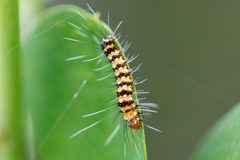
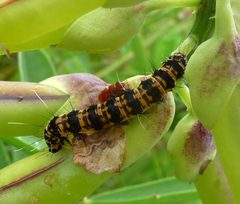
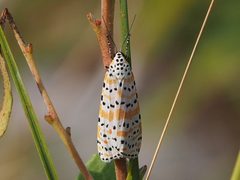
activity separates this from most North American . The combination of bright pink/orange/red/white wings with black markings, particularly the white forewing bands with irregular black spots and pink hindwings with black marginal band, distinguishes it from similar Utetheisa species. Larvae are orange and brown with irregular black bands and distinct white spots on and portions; they lack verrucae typical of most arctiid larvae.
Images
Habitat
Open areas supporting Crotalaria plants, including temperate midwestern and eastern North America, subtropical and tropical regions of Mexico, Central America, and South America. Found in scrub , disturbed areas, and agricultural fields of Crotalaria juncea.
Distribution
Southeastern United States (Connecticut west to southeastern Nebraska, south to southern New Mexico and Florida) through Mexico, Central America, and South America to southeast Brazil. More common in tropical portions of its range due to plant availability.
Diet
herbivore. Larvae feed on leaves, floral buds, green pods, and seeds of Crotalaria (Fabaceae), particularly Crotalaria juncea, C. rotundifolia, C. pallida, C. lanceolata, C. spectabilis, and C. retusa. Larvae sequester from plants. do not feed.
Host Associations
- Crotalaria juncea - primary plantleaves, floral buds, green pods, and seeds
- Crotalaria rotundifolia - plantnative ; higher alkaloid content than hosts
- Crotalaria pallida - plant ; supports faster larval development but lower alkaloid
- Crotalaria lanceolata - plant
- Crotalaria spectabilis - plant
- Crotalaria retusa - plant
Life Cycle
are spherical, white to yellow to brown. Larvae are orange and brown with irregular black bands and white spots, reaching 30–35 mm at maturity; they lack verrucae. Larvae feed on leaves in early instars, entering seed pods in second or third instar. Pupae are mostly black with irregular orange and brown bands, covered with loose silk. live three to four weeks. Development time varies with plant alkaloid content; higher alkaloid concentrations increase development time but do not affect final pupal size.
Behavior
activity pattern, unlike most . Larvae exhibit of , larvae, and occasionally pupae when alkaloid-deficient; this is driven by alkaloid deficiency rather than hunger. Larvae may recognize kin and are less likely to intrude upon siblings in seedpods. exhibit complex courtship beginning at dusk: stationary females release sexual in short pulses; males approach and flutter, exposing coremata (yellow spherical structures) that emit hydroxydanaidal pheromone. Copulation lasts up to 12 hours, with two hours for transfer and remaining time for alkaloid transfer. Females engage in "pheromonal chorusing" — collective pheromone release with related females to increase attractiveness.
Ecological Role
herbivore on Crotalaria . Chemical defense through sequestered renders larvae and unpalatable to most including spiders and insectivorous bats. When abundant, can act as defoliator pest of Crotalaria crops. Reduced by Chrysoperla externa due to prey can disrupt services.
Human Relevance
Used as model organism for studying , , and chemical . sequestered by larvae are toxic to humans and livestock; Crotalaria containing these compounds can cause liver and lung if ingested. The species has been evaluated for potential against Crotalaria species, though effectiveness may be compromised when reared on with lower alkaloid content.
Similar Taxa
- Utetheisa bellaFormerly considered separate ; now synonymized under U. ornatrix based on genetic evidence showing phenotypic differences represent geographic variation rather than species-level divergence
- Other Utetheisa speciesU. ornatrix distinguished by combination of activity, specific wing pattern (white bands with six irregular black spots, pink hindwings with black margin), and association with Crotalaria plants
More Details
Taxonomic history
Originally described by Linnaeus in 1758 as Phalaena ornatrix (paler specimens) and Phalaena bella (bright pink specimens). Hübner moved both to Utetheisa in 1819. Forbes united them as U. ornatrix in 1960; genetic studies by Pease Jr. (1966) confirmed this synonymy.
Sexual selection research significance
U. ornatrix is a premier model for studying . Females mate multiply (average 3–5 males, up to 13) and choose mates based on body size, alkaloid content, and hydroxydanaidal courtship intensity. Females perform postcopulatory sperm selection favoring males with higher hydroxydanaidal signals. The female preference gene is paternally inherited on the Z .
Chemical defense mechanism
Larvae sequester (PAs) from Crotalaria seeds and leaves, storing them through . When disturbed, secrete PA-laden foam from the . The gene pyrrolizidine-alkaloid-N-oxygenase enables detoxification; expression upregulates with dietary PA increase. Males transfer PAs to females via (up to 11% of male body mass), and females allocate one-third of received alkaloids to for offspring protection.
Subspecies
Three recognized: U. o. ornatrix, U. o. bella (Linnaeus, 1758), and U. o. saintcroixensis Pease, 1973.
Sources and further reading
- BugGuide
- Wikipedia
- GBIF taxonomy match
- iNaturalist taxon
- NCBI Taxonomy
- Catalogue of Life
- Encyrtid Holdings | Entomology Research Museum
- Isolation of five polymorphic microsatellite markers in Utetheisa ornatrix (Lepidoptera: Arctiidae)
- Chrysoperla externa (Neuroptera: Chrysopidae) and Utetheisa ornatrix (Lepidoptera: Arctiidae) on organically grown Crotalaria juncea (Fabaceae)
- You are what you eat: native versus exoticCrotalariaspecies (Fabaceae) as host plants of the Ornate Bella Moth,Utetheisa ornatrix(Lepidoptera: Erebidae: Arctiinae)