
Virbia costata
Stretch, 1884


Pronunciation
How to pronounce Virbia costata: /ˈvɪr.bi.ə kɒˈstaː.tə/
These audio files are automatically generated. While they are not always 100% accurate, they are a good starting point.
Identification
Specific identification features distinguishing V. costata from other Virbia are not documented in available sources. The species can be recognized by its geographic range and the documented in forewing length.
Images
Appearance
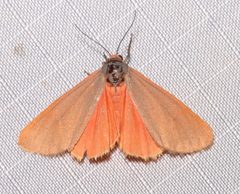
have forewings measuring approximately 11.7 mm in males and 13.5 mm in females. As a member of the Virbia, it likely exhibits the characteristic bright coloration typical of tiger moths in this group, though specific pattern details for this are not documented in available sources.
Habitat
Specific preferences are not documented. Based on its distribution in the western United States, it likely occurs in arid and semi-arid environments including grasslands and open woodlands.
Distribution
Western United States, ranging eastward to western Oklahoma and northward to Colorado.
Seasonality
are on wing in July in Arizona, New Mexico, Colorado, and Oklahoma. In the Big Bend region of Texas, adults have been observed in June and again in early August.
Diet
Larvae have been reared on plantain (Plantago). feeding habits are not documented.
Host Associations
- Plantago - larval food plantLarvae reared on plantain
Life Cycle
Larval stage feeds on plantain . and other developmental details are not documented.
Similar Taxa
- Other Virbia speciesMembers of the Virbia share similar body plans and bright coloration; accurate identification requires examination of genitalia or geographic range
More Details
Original description
First described as Crocota costata by Richard Harper Stretch in 1884, later transferred to the Virbia.
Sources and further reading
- BugGuide
- Wikipedia
- GBIF taxonomy match
- iNaturalist taxon
- NCBI Taxonomy
- Catalogue of Life
- Fran Keller: Entomologist, Teacher, Artist, Author | Bug Squad
- Bug Eric: New Mexico Dragonfly Blitz - Day 3
- Fascinating Invertebrates ~ Bring on the leeches! - Buglife Blog - Buglife
- Bizarre, beautiful extremes | Beetles In The Bush