
Stigmella corylifoliella
(Clemens, 1861) Wilkinson et al., 1979
Stigmella corylifoliella is a minute in the Nepticulidae, described by James Brackenridge Clemens in 1861. The has a wingspan of approximately 3.5 mm and is distributed across much of North America, from the eastern United States to the Pacific coast and southern Canada. Its larvae are leaf miners that feed on a diverse array of plants.
Pronunciation
How to pronounce Stigmella corylifoliella: /ˈstɪgmɛlə ˌkɔrɪlɪˈfoʊliə/
These audio files are automatically generated. While they are not always 100% accurate, they are a good starting point.
Identification
Identification to level typically requires examination of genitalia or , as is standard for Nepticulidae. The specific epithet 'corylifoliella' references Corylus (hazel), one of its larval plants. The Hodges number 0092 provides a reference for North American lepidopterists.
Images
Habitat
Found in regions supporting its diverse plants, including deciduous forests, shrublands, and areas where Vaccinium, Corylus, Betula, Alnus, and other host occur. The ' broad host range suggests adaptability to varied within its geographic distribution.
Distribution
North America: United States (Ohio, New Jersey, Maine, Michigan, Kentucky, California, Pennsylvania, Maryland, North Carolina) and Canada (Ontario, New Brunswick, Quebec, British Columbia). The transcontinental distribution spanning both Atlantic and Pacific coasts is notable for a of this size.
Diet
Larvae are leaf miners, feeding internally on leaf tissue of plants. Documented hosts include: Vaccinium (blueberries), Corylus (hazel, including Corylus americana), Opulaster, Betula (birch), Gaylussacia (huckleberry), Hamamelis virginiana (American witch-hazel), and Alnus rugosa var. americana (speckled alder). The broad host range across multiple plant is unusual for Stigmella , many of which are more specialized.
Host Associations
- Vaccinium - larval leaf mining
- Corylus americana - larval leaf mining; specific epithet references this
- Opulaster - larval leaf mining
- Betula - larval leaf mining
- Gaylussacia - larval leaf mining
- Hamamelis virginiana - larval leaf mining
- Alnus rugosa var. americana - larval leaf mining
Life Cycle
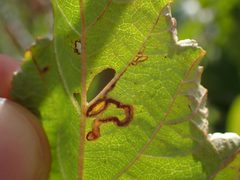
Larvae mine leaves of plants, creating characteristic tunnels visible as pale trails or blotches on leaf surfaces. occurs within the leaf mine or in soil. are active during warmer months, though specific is poorly documented.
Behavior
are presumably or , as is typical for Nepticulidae. Larvae feed as internal leaf miners, with visible within mines. The ' broad plant range suggests ecological flexibility uncommon in the .
Ecological Role
As a , larvae contribute to nutrient cycling through their feeding activity and may serve as prey for and other natural enemies. The ' persistence on multiple may provide ecological stability where any single host is scarce.
Human Relevance
No significant economic impact documented. The is of interest to lepidopterists and ecologists studying plant-insect relationships. Its broad range makes it a subject for research on host switching and ecological generalization in .
Similar Taxa
- Stigmella castaneaefoliellaAlso a leaf-mining Nepticulidae with broad range; distinguished by association with Castanea (chestnut) rather than the host of S. corylifoliella
- Other Stigmella speciesMany are more -specific; S. corylifoliella is notable for its unusually broad host range across multiple plant
More Details
Taxonomic History
Originally described as Nepticula corylifoliella by Clemens in 1861, later transferred to Stigmella. The has been subject to modern taxonomic revision as part of broader work on North American Nepticulidae.
Hodges Number
0092 in the North American numbering system, facilitating reference in regional faunal works.