
Ectoedemia platanella
(Clemens, 1861) Wilkinson et al., 1979
sycamore leaf blotch miner
Ectoedemia platanella is a minute in the Nepticulidae, commonly known as the sycamore . It is restricted to the eastern United States, where its larvae create distinctive blotch mines in leaves of Platanus . The species is highly -specific and represents one of many specialized leaf-mining moths in this diverse family.
Pronunciation
How to pronounce Ectoedemia platanella: /ˌɛk.toʊ.ɪˈdiː.mi.ə ˌplætəˈnɛlə/
These audio files are automatically generated. While they are not always 100% accurate, they are a good starting point.
Identification
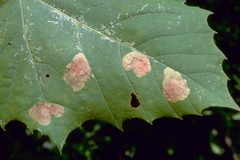
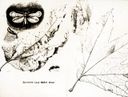
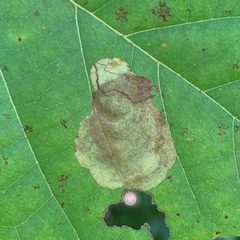
are identified by their extremely small size and narrow, pointed wings with reduced venation—features characteristic of Nepticulidae. The is most reliably identified by association with its distinctive larval mines in Platanus leaves: irregular blotch mines that begin as slender linear tracks then expand into rounded blotches. The mines contain scattered (larval excrement) and are usually found on the upper leaf surface. Similar Ectoedemia species on other can be distinguished by host association and mine .
Images
Habitat
Deciduous forests and urban areas where Platanus (sycamores and plane trees) occur. Found in riparian zones, floodplains, and planted landscapes with trees present.
Distribution
Eastern United States (Nearctic region). Specific range boundaries are not well documented, but records indicate presence throughout the eastern portion of the country where suitable plants occur.
Diet
Larvae feed on Platanus (sycamores and plane trees). Specific plant parts consumed are leaf mesophyll tissue within mines. do not feed; mouthparts are or reduced, as is typical for many Nepticulidae.
Host Associations
- Platanus - larval Larvae mine leaves of Platanus
Life Cycle
Complete with , larva, pupa, and stages. Larvae are leaf miners that feed within Platanus leaves, creating blotch mines. occurs within the mine or in leaf litter. Specific timing of and stage are not documented.
Behavior
Larvae are endophagous leaf miners, feeding entirely within leaf tissue and creating visible blotch mines. are presumably or given tendencies, but specific activity patterns are unrecorded.
Ecological Role
As a , larvae contribute to herbivore diversity on Platanus and may serve as prey for and other natural enemies. Mines cause minor aesthetic damage to leaves but are not considered ecologically significant.
Human Relevance
Minor ornamental pest when abundant on landscape Platanus trees; leaf mines are visible but do not cause serious tree damage. Occasionally noted in urban forestry and arboricultural contexts.
Similar Taxa
- Other Ectoedemia speciesMany are similar in size and wing ; plant association and larval mine characteristics are primary distinguishing features.
- Other Nepticulidae on PlatanusFew other nepticulids are documented on Platanus; Ectoedemia platanella appears to be the primary on this in its range.