
Sthenopis argenteomaculatus
(Harris, 1841)
Silver-spotted Ghost Moth
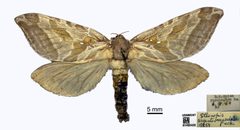
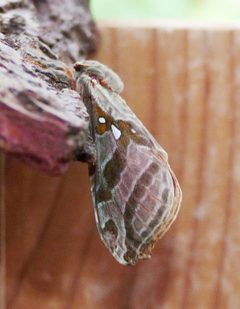
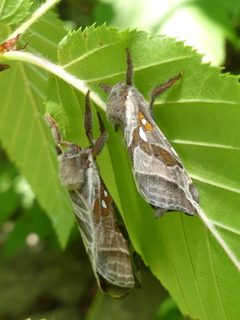
Sthenopis argenteomaculatus, the silver-spotted , is a large hepialid native to eastern North America. It is notable for its primitive wing venation, which retains four separate branches on the hind wing rather than the single found in most Lepidoptera. The has a two-year and larvae bore into the roots of woody plants in wet environments.
Pronunciation
How to pronounce Sthenopis argenteomaculatus: //ˌsθɛnəˈpɪs ˌɑːrdʒɛnˌtiːoʊˌmækjʊˈleɪtəs//
These audio files are automatically generated. While they are not always 100% accurate, they are a good starting point.
Identification
Distinguished from other large by the primitive wing venation with four separate branches on the hind wing . The gray-tan forewings with irregular dark bands and large size separate it from most regional hepialids. active in summer, unlike some spring-active ghost moths.
Images
Appearance
Large with wingspan 65–100 mm. Forewings gray to tan with irregular dark transverse bands. Hindwings lack the typical costal of most Lepidoptera, instead retaining four separate branches—a primitive trait. Body robust, typical of ghost moths.
Habitat
Associated with wet environments where plant roots are partially submerged in water. Larval specifically requires roots of woody plants in saturated or aquatic soils.
Distribution
Eastern North America from Nova Scotia south to North Carolina (sources vary on southern limit: Virginia per iNaturalist, North Carolina per Wikipedia) and west to Minnesota. Present in Canada and United States.
Seasonality
on wing June to August.
Diet
Larvae feed on roots of Alnus (alders), Betula (birches), and Salix (willows). do not feed.
Host Associations
- Alnus - larval food plantroots partially submerged in water
- Betula - larval food plantroots partially submerged in water
- Salix - larval food plantroots partially submerged in water
Life Cycle
Two-year . Larvae bore into roots of plants. occurs after two years of larval development.
Behavior
Larvae bore into woody roots in wet substrates. are or . Notable for historical use in entomological education regarding primitive wing venation.
Ecological Role
Root-boring larvae likely contribute to nutrient cycling in riparian and wetland . Role as food source for not documented.
Human Relevance
Used extensively by John Henry Comstock and Anna Botsford Comstock in educational publications on Lepidopteran wing venation, with figures reproduced in multiple works including title pages. No economic significance documented.
Similar Taxa
- Other HepialidaeMost Lepidoptera including other ghost moths have hind wing costal ; S. argenteomaculatus retains the primitive four-branched condition
- Sthenopis thuleLarger Arctic/subarctic with overlapping range in northern areas; distinguished by size and more northerly distribution
More Details
Historical significance
John Henry Comstock frequently used this to illustrate primitive wing venation in his publications on Lepidopteran . Figures were prepared by Anna Botsford Comstock and reproduced on at least one title page.
Nomenclatural note
Date of description cited as 1841 (GBIF, Catalogue of Life) or 1842 (iNaturalist); Harris 1841 is the accepted original publication.