
Korscheltellus
Börner, 1920
conifer swift (for K. gracilis), common swift (for K. lupulina)
Species Guides
2- Korscheltellus gracilis(Conifer Swift Moth)
- Korscheltellus lupulina(Common Swift Moth)
Korscheltellus is a of ghost moths (Hepialidae) containing two widespread . Korscheltellus lupulina, the common swift, occurs across Europe. Korscheltellus gracilis, the conifer swift, ranges through Canada and the eastern United States. The genus was established by Börner in 1920 and has been subject to taxonomic revision, including the reinstatement of Korscheltellus castillanus as a distinct species.
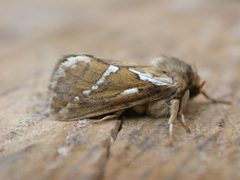
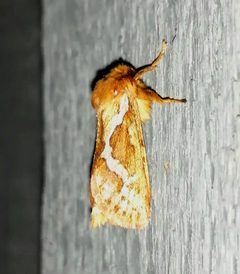
Images
Habitat
Forested ; montane forests in North American ranges. Korscheltellus gracilis is associated with coniferous forest containing balsam fir and red spruce.
Distribution
Europe (K. lupulina); Canada and eastern United States (K. gracilis). Distribution records from Denmark, Norway, and Sweden have been documented.
Host Associations
- Abies balsamea - larval balsam fir; K. gracilis considered a major pest
- Picea rubens - larval red spruce; K. gracilis considered a major pest
- Populus tremuloides - larval quaking aspen; recorded for K. gracilis
- Picea glauca - larval white spruce; recorded for K. gracilis
- Betula alleghaniensis - larval yellow birch; recorded for K. gracilis
Human Relevance
Korscheltellus gracilis is considered a major pest of balsam fir and red spruce in North American forestry. The has been subject to surveys and utilization studies in Vermont to inform management practices.
Similar Taxa
- PharmacisClosely related within Hepialidae; both genera contain day-flying restricted to European mountain ranges. Distinguished by morphological and genitalic characters, with molecular analysis supporting their separation.
Sources and further reading
- BugGuide
- Wikipedia
- GBIF taxonomy match
- iNaturalist taxon
- NCBI Taxonomy
- Catalogue of Life
- Spatial and Temporal Distribution of Korscheltellus gracilis Larvae (Lepidoptera: Hepialidae) in the Green Mountains, Vermont
- Mating systems in primitive Lepidoptera, with emphasis on the reproductive behaviour of Korscheltellus gracilis (Hepialidae)
- Survey Methods, Distribution, and Seasonality of Korscheltellus gracilis (Lepidoptera: Hepialidae) in the Green Mountains, Vermont
- Inferences of Korscheltellus gracilis (Lepidoptera: Hepialidae) Habitat Utilization from Sticky Trap Catches on Camels Hump Mountain, Vermont
- A new species of Pharmacis Hübner, 1820 from Spain with a brief review of the genera Pharmacis and Korscheltellus Börner, 1920 (Lepidoptera, Hepialidae)