
Gazoryctra pulcher
(Grote, [1865])
Gazoryctra pulcher is a in the Hepialidae, a group commonly known as ghost moths or swift moths. It is known from the southwestern United States, with records from Colorado, New Mexico, and Utah. The species was described by Augustus Radcliffe Grote in 1865. Like other hepialid moths, it likely exhibits primitive moth characteristics including reduced mouthparts in .
Pronunciation
How to pronounce Gazoryctra pulcher: /ɡæzəˈrɪktrə ˈpʊlkər/
These audio files are automatically generated. While they are not always 100% accurate, they are a good starting point.
Identification
Gazoryctra pulcher can be distinguished from other Gazoryctra by its known distribution in the southwestern United States (Colorado, New Mexico, Utah) and its specific wing . Within Hepialidae, Gazoryctra species are generally smaller than many other ghost moths. Accurate identification to species level requires examination of genitalia and comparison with .
Images
Appearance
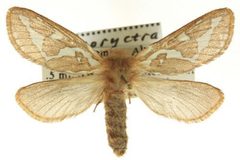
Wingspan approximately 33 mm. As a member of Hepialidae, likely have broad wings, relatively short , and a robust body typical of the . Specific coloration and pattern details are not documented in available sources.
Habitat
Specific preferences are not documented. As a hepialid , it likely inhabits montane or forested regions given its distribution in the Rocky Mountain and Colorado Plateau regions.
Distribution
Known from the United States: Colorado, New Mexico, and Utah. Records indicate presence in the southwestern United States, specifically in the Rocky Mountains and Colorado Plateau regions.
Life Cycle
As a hepialid , G. pulcher likely has a primitive with larvae that feed on decaying organic matter, roots, or fungal in soil or leaf litter. have reduced or non-functional mouthparts and do not feed. Specific details of its life cycle are not documented.
Behavior
hepialid typically exhibit or activity. Males may patrol areas to locate females, which release . Specific for G. pulcher are not documented.
Similar Taxa
- Other Gazoryctra speciesSimilar size and ; require genitalia examination for definitive identification
- Hepialus speciesLarger hepialid with overlapping ranges in western North America; distinguished by larger size and different wing patterns
- Korscheltellus speciesSmall hepialids with similar appearance; distinguished by distribution and subtle morphological differences
More Details
Taxonomic history
The was described by Augustus Radcliffe Grote in 1865. The Gazoryctra was established to accommodate small hepialid with distinctive morphological features.
Collection records
Only 3 observations are recorded in iNaturalist as of the data cutoff, indicating the is rarely encountered or underreported.