
Phyllocnistis vitegenella
Clemens, 1859
Phyllocnistis vitegenella is a small in the Gracillariidae, native to North America, with established in Europe since the 1990s. The larvae are leaf miners that feed on grape , including both native Vitis and cultivated Vitis vinifera, and have become recognized as a pest of commercial vineyards. The species was first described by Clemens in 1859.
Pronunciation
How to pronounce Phyllocnistis vitegenella: //ˌfɪloʊˈknɪstɪs ˌvaɪtəˈdʒɛnɛlə//
These audio files are automatically generated. While they are not always 100% accurate, they are a good starting point.
Images
Habitat
Associated with grapevine , including both wild and cultivated settings. The occurs in vineyards, riparian corridors, and other areas where plants of the Vitis are present.
Distribution
Native to North America, with records from Canada (Ontario, Quebec) and the United States (Alabama, California, Florida, Kentucky, Maine, Massachusetts, Mississippi, Pennsylvania, Tennessee, Vermont, Wisconsin). Introduced to Europe, with confirmed records from northern Italy (1994), Slovenia (2004), Switzerland (2009), Hungary, Romania, and Slovakia.
Diet
Larvae feed on leaves of grapevine (Vitis), including native North American Vitis species and the cultivated European grape Vitis vinifera.
Host Associations
- Vitis vinifera - food plantcultivated European grape, a major
- Vitis - food plantnative North American grape
Life Cycle
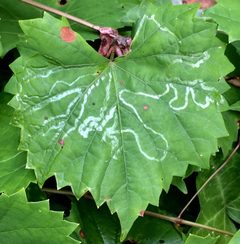
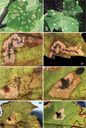
Larval stage consists of leaf miners that feed between the layers of plant leaves. are . Specific details of , stage, and number of per year are not documented in available sources.
Behavior
Larvae create mines in leaves of plants. are and attracted to light.
Ecological Role
Herbivore; larval feeding activity as a . In its introduced European range, it has become a pest in agricultural .
Human Relevance
Recognized as a pest of cultivated grapevines (Vitis vinifera) in Europe. The has economic significance in viticulture due to larval damage to vineyard foliage.