
Phyllocnistis populiella
Chambers, 1875
common aspen leaf miner, aspen serpentine leafminer, Aspen Serpentine Leafminer Moth
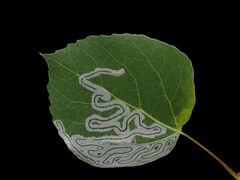
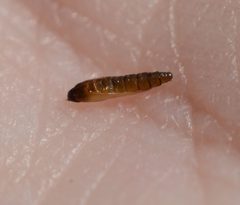
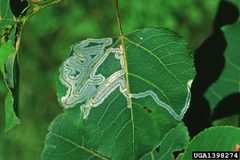
Phyllocnistis populiella is a microlepidopteran leaf-mining in the Gracillariidae. It has become common and abundant in western North America, where it feeds exclusively on Populus tremuloides (trembling aspen) and P. balsamifera (balsam poplar). Larvae create serpentine mines in the epidermal layer of leaves, with heavy causing mid-summer defoliation. The exhibits remarkable cold hardiness, as larvae in leaf litter with freeze to -40°C.
Pronunciation
How to pronounce Phyllocnistis populiella: //ˌfɪloʊkˈnaɪstɪs ˌpɒpjʊˈliːɛlə//
These audio files are automatically generated. While they are not always 100% accurate, they are a good starting point.
Identification
Identified by the characteristic serpentine leaf mines on Populus tremuloides or P. balsamifera; mines are restricted to the single epidermal layer on upper or lower leaf surfaces. In northern North America, the association with aspen and the specific mine pattern distinguishes it from other Phyllocnistis . are minute and require microscopic examination for definitive identification; many species in this require genitalia dissection for confirmation.
Images
Habitat
Associated with stands of trembling aspen (Populus tremuloides) and balsam poplar (Populus balsamifera). larvae occur in the lower 5 cm of leaf litter beneath trees, where temperatures are moderated compared to ambient air. Distribution within tree crowns is uneven, with more laid in the lower crown levels.
Distribution
Northern North America including Alberta, British Columbia, Manitoba, New Brunswick, Newfoundland and Labrador, Ontario, Massachusetts, and Alaska. Has become particularly common and abundant in western North America. Study in interior Alaska (near Fairbanks) demonstrate successful survival at extreme high-latitude conditions.
Seasonality
Overwintered emerge and lay on young aspen leaves in spring. New- adults emerge approximately two months later. Larval feeding occurs primarily in a concentrated period of about one week during the third instar. Heavy attack results in defoliation by mid-summer. Optimal temperatures for activity are narrowly defined: 50-55°F for copulation, 54-56°F for feeding, and 52-58°F for oviposition.
Diet
Larvae feed exclusively on the single epidermal layer of aspen leaves (Populus tremuloides and Populus balsamifera), creating serpentine mines between the upper and lower leaf surfaces. Most feeding is concentrated in the third instar over approximately one week.
Host Associations
- Populus tremuloides - primary trembling aspen; only authoritatively identified in early literature, now known to also use balsam poplar
- Populus balsamifera - primary balsam poplar; confirmed as in Alaska studies
Life Cycle
Overwinters as larvae in leaf litter beneath trees. Overwintered emerge in spring and lay singly near the apex of young aspen leaves. Eggs are evenly spaced, with distribution uniform within particular crown levels though more abundant in lower crown. Larvae develop through instars with most feeding by the third instar in about one week. occurs in the mine or leaf litter. New- adults emerge after approximately two months. Females can develop more than 40 eggs but typically lay only about 7 due to limited opportunities.
Behavior
Larvae position themselves in the lower 5 cm of leaf litter for , a behavioral strategy that moderates exposure to extreme cold. Exhibits seasonal in cold hardiness: autumn-collected larvae show greater freeze than summer-collected larvae. are active in narrow temperature windows, with specific thermal optima for copulation, feeding, and oviposition.
Ecological Role
Herbivorous causing defoliation of aspen; heavy attack can result in complete defoliation by mid-summer. Contributes to nutrient cycling through leaf litter deposition. are strongly influenced by climatic factors, with mortality in larval and pupal stages often high; decline typically follows mortalities above 70%. sometimes plays an important role in , though geographic independence of population changes suggests climate as a factor.
Human Relevance
Considered a pest in forest management contexts due to capacity for extensive defoliation of aspen stands. trends and damage can be assessed through permanent plots; expected damage may be predicted from estimates of new- populations. Sampling is improved by using individual leaf surface rather than whole leaf as the basic sample unit, and by sampling more trees with fewer branches per tree.
Similar Taxa
- Phyllocnistis citrellacitrus leafminer in same ; distinguished by association (citrus vs. aspen/poplar) and geographic range
- Other Phyllocnistis speciesmany create similar serpentine mines; definitive identification often requires genitalia dissection and plant association
More Details
Cold Hardiness Physiology
Larvae exhibit freeze with supercooling points around -20°C and survival to -40°C. Winter survival exceeds 80% despite extreme cold. This represents exceptional cold hardiness for a leaf-mining insect, facilitated by behavioral through microhabitat selection in leaf litter.
Population Dynamics
changes are independent between broad geographic areas, suggesting strong climatic control rather than -driven dynamics. High mortality thresholds (>70%) typically precede population declines, indicating boom-bust population cycles driven by -dependent and climatic factors.
Reproductive Limitation
Females have substantial production potential (>40 eggs) but realize only about 7 eggs per female due to limited oviposition opportunities, suggesting strong resource or time limitation on reproductive output.
Sources and further reading
- BugGuide
- Wikipedia
- GBIF taxonomy match
- iNaturalist taxon
- NCBI Taxonomy
- Catalogue of Life
- Biological Control in Brazil is Used on an Area that is Larger than Belgium
- Bug Eric: Don't Ignore the Small Bugs!
- Bug Eric: November 2016
- Bug Eric: 2016
- Overwintering Physiology and Microhabitat Use of Phyllocnistis populiella (Lepidoptera: Gracilliariidae) in Interior Alaska
- Bionomics of the Aspen Leaf Miner, Phyllocnistis populiella Cham. (Lepidoptera: Gracillariidae)
- Mining Patterns of the Aspen Leaf Miner,Phyllocnistis populiella, on Its Host Plant,Populus tremuloides
- Characterizing Spatial Distributions of Insect Pests Across Alaskan Forested Landscape: A Case Study Using Aspen Leaf Miner (Phyllocnistis populiellaChambers)